
Aug 15, 2026
Why Choose Heavy Duty Office Desks for High-Intensity Workspaces?
Choosing Heavy Duty Office Desks for high-intensity workspaces means investing in furniture engineered to handle demanding commercial environments where standard office solutions fall short. These specialized work surfaces feature reinforced steel frames and industrial-grade materials capable of supporting heavy equipment, multiple monitors, and constant daily use across shifts without structural failure. Unlike residential-grade furniture, these desks provide the stability, durability, and ergonomic support essential for command centers, manufacturing offices, healthcare administrative hubs, and enterprise environments requiring reliability under pressure.
Understanding Heavy Duty Office Desks and Their Core Advantages
When purchasing managers look at office furniture, it's important for them to know what makes commercial-grade desks different from standard desks. Heavy Duty Office Desks are designed solutions that are based on specific performance measures rather than just fashion trends.
What Defines a Heavy Duty Office Desk?
The frames of these desks are made of 12 to 16-gauge cold-rolled steel that has been coated with an anti-corrosive powder that makes them last longer in harsh conditions. The work surfaces are usually made of high-pressure laminate attached to high-density fibreboard. This makes surfaces that are scratch- and moisture-resistant and keep their look even after a lot of use. Most of the time, they can hold more than 500 pounds of static load, and motorised versions that can change height can handle 350 pounds or more of dynamic load when the position is changed. This construction meets ANSI/BIFMA X5.5 standards, which are higher safety standards for business furniture than those for home furniture.
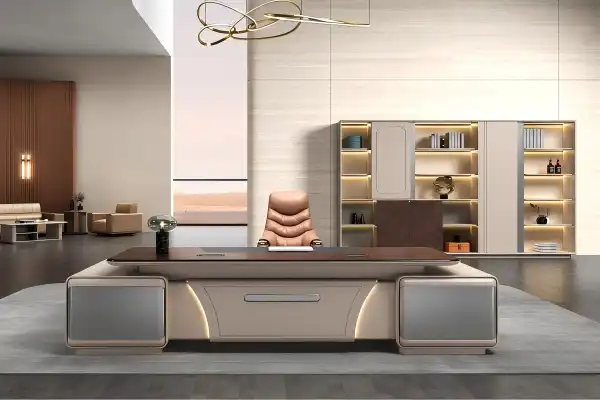
This method is shown by PENGPAI's Heavy Duty Office Desks Manager Desk, which has a modular design and a warm wood-grain desk with stepped sides and a light-colored panel in the middle. The desk has two square cabinets covered in grey leather with fine stitching and a horizontal storage unit. Curved LED lighting built into the joints provides both functional lighting and visual depth. The well-thought-out arrangement meets both storage needs and professional standards.
Key Benefits That Drive ROI
The benefits go beyond longevity in terms of operating efficiency and cost management. When used heavily, these desks last 10 to 15 years, compared to the three to five years that regular office furniture might need to be replaced. When you look at large-scale deployments, this longer lifespan directly leads to a lower total cost of ownership.
Integrated cable management systems keep power and data connections neat, which cuts down on downtime caused by cables getting tangled or being accidentally disconnected while equipment is being adjusted. Motorised versions have anti-collision technology that keeps people and expensive equipment safe when changing heights. The structural rigidity stops the shaking that makes it hard to be precise and makes people angry when they have to type or use heavy equipment for long periods of time.
Selecting the Right Desk for Your Specific Requirements
If you want to make smart buying choices, you need to carefully compare products using measurable criteria instead of depending on first thoughts or few product comparisons.
Essential Decision Metrics
The main feature of Heavy Duty Office Desks is the weight capacity, but buyers should also calculate the total load, including not only computers and monitors but also document storage, work tools, and specialised equipment required for specific industries. A Heavy Duty Office Desks solution with a capacity of up to 500 pounds is suitable for most multi-monitor workstations with desktop towers, while command centres with six or more displays and advanced communication equipment may require stronger load thresholds. Selecting the right Heavy Duty Office Desks requires a complete understanding of workplace demands to ensure long-term reliability and safety.
The choice of surface material for Heavy Duty Office Desks affects both durability and maintenance requirements. High-pressure laminate provides better resistance to scratches and chemicals compared with melamine, making it a suitable option for laboratories and industrial environments where strong cleaning products are frequently used. Thermally fused laminate offers a practical balance between durability and cost, making it ideal for standard office applications with regular equipment. By choosing suitable materials, Heavy Duty Office Desks can maintain their appearance and performance even in demanding working conditions.
When Heavy Duty Office Desks are used across multiple shifts in 24/7 workplaces, ergonomic flexibility becomes essential. Different users require different desk heights to maintain comfort and productivity, while fixed-height desks may increase fatigue and reduce efficiency. Height-adjustable Heavy Duty Office Desks with memory presets allow users to switch positions quickly without manual measurement or repeated adjustments, improving workplace adaptability. Investing in flexible Heavy Duty Office Desks helps create a more efficient, comfortable, and productive working environment for different types of users.
Supplier Evaluation Beyond Product Specifications
Quality alone doesn't mean a project will be successful. Throughout the whole project lifecycle, procurement managers should look at how well suppliers can do their jobs. Does the company offer technical drawings and help with planning your space before you buy? Can they handle requests for customisations like non-standard sizes or branding integration without adding too much to the lead time?
Stability in production is important, especially for phased deployments or rollouts in multiple locations that need consistency across delivery runs. Suppliers with strong quality control systems and well-documented production methods make it less likely that original samples and final production units will not be exactly the same. This consistency keeps customers from getting frustrated when they get furniture that doesn't match the accepted samples.
These worries are directly addressed by PENGPAI's structure that combines manufacturing and trading. Our Foshan plant keeps a ready supply of core products on hand and also has in-house engineering teams that can help with project-based customisation by giving 2D and 3D models for approval before production begins. Communication and delivery schedules are coordinated by dedicated project managers, which makes it easier for busy procurement teams to handle multiple vendors.
Current Market Leaders and Product Options for 2024
New materials and manufacturing methods are always being used to change the business furniture market. However, a few well-known companies have been around for a long time and have strong places thanks to their proven performance and complete support systems.
Comparative Overview of Top Providers
Herman Miller made its name by doing research on ergonomics and coming up with new ways to make things. Their business desks work perfectly with their chairs and accessory collections, making workspaces that look good together and use the same design language. Weight capacities are usually between 300 and 400 pounds. Brand positioning and large dealer networks provide local support, which explains the higher prices.
Steelcase looks at things as a whole, and their desks are just one part of bigger workspace options. This integration helps companies that are putting in place complete workplace plans, but it may make things more difficult for people who want to buy a desk on its own. The quality of the materials meets industrial standards, and there are strong warranties to back up claims of efficiency.
Global Industrial focuses on providing cost-effective solutions for industrial and warehouse offices that need to last for a long time. Their line of products includes basic Heavy Duty Office Desks that cost less than $500. This means that smaller businesses or startups that are just starting out can get commercial-grade furniture.
Budget Considerations and Value Analysis
Premium names cost more at first, but the total cost should be calculated by adding up how often they need to be replaced, how much the guarantee covers, and how much it costs to have to shut down. A $1,200 desk that needs little upkeep and lasts 12 years is a better deal than a $400 desk that needs to be replaced every four years, especially when you think about how much it costs to dispose of the old desk and how much time is lost during furniture changes.
The ability to buy in bulk has a big effect on the cost per unit. Many manufacturers offer discounts for buying in bulk starting at 10 to 20 units. The discounts get bigger for bigger orders. PENGPAI supports bulk orders and flexible customisation, which lets companies keep the design consistent while changing furniture to meet the needs of different departments within the same project.
Extending Lifespan Through Proper Maintenance
Even commercial-grade furniture needs to be taken care of properly to get the most out of its life and keep its professional look while it's in use.
Routine Maintenance Protocols
Cleaning methods should be matched to the surface. Most store-bought cleaners won't hurt high-pressure laminate, but rough scrubbing can wear down protection layers over time. Use pH-neutral cleaners on wood-grain finishes so that the protection layers don't come off. Periodically checking metal frames for paint chips or scratches that could cause rust is a good idea, especially in damp places or places where salt is present.
Every six months, the structure should be checked to make sure that the link points are still stable and tight. According to the maker, motorised desks need to have their lifting mechanisms oiled every so often, usually once a year or after a certain number of rounds. This kind of preventive maintenance doesn't take long and keeps machines from breaking down, which could damage equipment or put people in danger.
Ergonomic Integration for User Health
Choosing the right desk is only one part of ergonomics at work. People can't get health benefits from even the most high-tech adjustable desk if they don't set it up correctly and use the right chairs and accessories with it. The right desk height places the computer and mouse so that your wrists stay flat on the floor and your shoulders are relaxed. The monitor height should put the top of the screen at or just below eye level so that you don't have to strain your neck while watching for long periods of time.
Anti-fatigue mats help people who use standing desks by easing the stress on their feet and legs after long times of standing. Adjustable monitor arms let you finetune the position of the screen regardless of the surface of the desk. This means that people of different heights can use the same monitors without having to buy separate desks. The functional value of good desks is improved by these add-ons, which are much cheaper than the desks themselves.
Why High-Intensity Workspaces Demand Specialized Solutions
Knowing what problems regular office furniture has can help you see why it's worth spending money on custom-made solutions in business settings.
Performance Gaps in Standard Office Desks
Residential-grade office furniture is made for occasional home offices with light loads of equipment. Most of the time, these desks can safely hold up to 100 to 150 pounds, which is enough for a laptop and a few books but not at all for professional setups with two monitors and desktop computers. When cheap furniture is loaded for a long time, the particle board core contracts, deforming the surface permanently and making work surfaces unsteady.
Steel desks are strong, but they don't always have ergonomic features and can be hard to keep cables organised. The strictly useful industrial style might work in warehouses, but it doesn't look right in executive rooms or offices where people come in to talk to you. When moving or reconfiguring, weight becomes an issue, which means more work and a higher total cost of ownership.
Real-World Applications and User Experience
Command centers and emergency call centers show how important it is for furniture to work well. The tech in these places is worth thousands of dollars per computer and is always on. If a desk fails and breaks computers or stops operations during an emergency, the effects are much worse than the cost of replacing the furniture. Heavy Duty Office Desks are the best choice for these uses because they are stable and reliable.
Healthcare administrative offices have to deal with both the amount of equipment and the need for cleanliness. Desks that hold medical records systems, testing equipment connections, and communication tools need to be strong and have surfaces that can be cleaned often with hospital-grade disinfectants. The Heavy Duty Office Desks manager desk from PENGPAI is certified by SGS CEC and meets E0 formaldehyde emission standards. This means that it can help with indoor air quality issues that are very important in healthcare settings.
Trading floors in businesses need furniture that can handle quick equipment changes without having to replace desks. Commercial desks are designed to be modular, so they can be changed to meet new technology needs without having to replace all the furniture. This ability to adapt saves investments in furniture as companies change their technology systems.
Conclusion
To choose the right work areas for tough commercial settings, you need to know about the engineering, materials, and support systems that make purpose-built business furniture different from consumer options. Heavy Duty Office Desks have measurable benefits in terms of durability, equipment support, and total cost of ownership when looking at the whole service lifecycle instead of just the purchase price. When companies invest in good office facilities, they lower their long-term costs and create places where people can be productive and healthy. The key is to work with manufacturers who understand what businesses need and can provide full support from the beginning of the design process through years of use.
FAQ
What weight capacity should I specify for multi-monitor workstations?
Add 30% to the total load to account for safety. This should include monitors, hanging gear, computers, and any other specialised equipment. Two-monitor setups with desktop computers usually need 250 to 300 pounds of space, while command centers with six screens need 500 pounds or more.
What's the difference between heavy-duty desks and regular steel desks?
Heavy Duty Office Desks have features like ergonomics, wire management, and a more refined look that aren't found on industrial steel desks alone. They have engineered surface materials that don't scratch or get wet and keep their professional look. Steel desks, on the other hand, put durability over user comfort.
Are financing options available for large-scale deployments?
There are many places that sell business chairs that let you pay over time for large orders. PENGPAI works with buying teams to set up payment plans that are in line with the budget cycles and stages of a project. Get in touch with our staff at kiki@pengpaifurniture.com to talk about your choices.
Partner with PENGPAI for Your High-Intensity Workspace Solutions
PENGPAI has been making things for 16 years and can help with commercial workspace problems in government buildings, hospitals, corporate offices, and hospitality projects. Our Heavy Duty Office Desks Manager Desk is made of strong materials and comes with smart storage solutions and built-in LED lighting. It's available right away from our warehouse in Foshan and has SGS CEC approval and a five-year shelf life. As both a manufacturer of Heavy Duty Office Desks and an integrated trading partner, we help projects from the beginning of space planning to the end of installation by providing specialised project management, expert drawing help, and quick service after the sale. Our engineering team can meet your needs for customisation in terms of size, material, and marking integration without affecting the reliability of delivery. Email us at kiki@pengpaifurniture.com to talk about your project needs and get detailed specifications that are made to fit your workspace.
References
1. American National Standards Institute. (2019). ANSI/BIFMA X5.5 Desk Products Testing Standard. Business and Institutional Furniture Manufacturers Association.
2. Robertson, M.M., Huang, Y.H., & Lee, J. (2017). Improvements in Musculoskeletal Health and Computing Behaviors: Effects of a Problem-Solving Intervention. Journal of Occupational and Environmental Medicine, 59(8), 768-776.
3. Hedge, A. (2016). Ergonomic Workplace Design for Health, Wellness, and Productivity. CRC Press, Taylor & Francis Group.
4. GREENGUARD Environmental Institute. (2021). Indoor Air Quality Certification Standards for Low-Emitting Products. UL Environment.
5. Chen, L. & Zhang, W. (2020). Materials Science in Modern Office Furniture Manufacturing. Industrial Design and Engineering Journal, 34(2), 112-128.
6. Workplace Furniture Research Consortium. (2023). Total Cost of Ownership Analysis for Commercial Workspace Furniture. International Facility Management Association White Paper.
Online Message