
Aug 19, 2026
What is an Open Space Staff Desk and How Does It Affect Work?
An Open Space Staff Desk is a modular workstation designed specifically for collaborative office environments where spatial efficiency and team interaction drive productivity. Unlike traditional enclosed cubicles, these desks feature shared structural frameworks and minimalist privacy screens that maximize floor space while preserving individual work zones. The design philosophy behind these workstations addresses three persistent workplace challenges: overcrowded layouts, disorganized cable management, and the psychological strain caused by isolated, rigid office setups. By integrating clean aesthetics with high-density functionality, these desks encourage natural light distribution, better airflow, and spontaneous collaboration—all essential for retaining talent and supporting agile project workflows in competitive commercial sectors.

Understanding Open Space Staff Desks: Definition and Key Features
What Defines an Open Space Staff Desk?
Open Space Staff Desks differ fundamentally from conventional office furniture because they focus on being flexible and letting people see each other. The frames of these desks are usually made of cold-rolled steel with an electrostatic powder coating, which makes them strong and resistant to scratches and corrosion over time. The desk tops are made of high-pressure laminate or melamine-faced chipboard that meets E0 or E1 environmental standards. This makes sure that there are low formaldehyde emissions, which is important for keeping the air quality healthy in offices with lots of people.
Core Structural Components
There are a few important parts of modern open desk setups that make them combine openness with practical needs. Noise Reduction Coefficients of 0.5 or higher are reached by privacy screens made from tackable acoustic fabric. These screens block out background noise without blocking all views across the office floor. Integrated wire management systems keep data cables and high-voltage power lines separate. This stops electromagnetic interference that can damage sensitive equipment. Mobile pedestals that fit under desks offer personal storage without getting in the way of the clean, uncluttered look that defines modern workspaces.
Innovative Design Integration
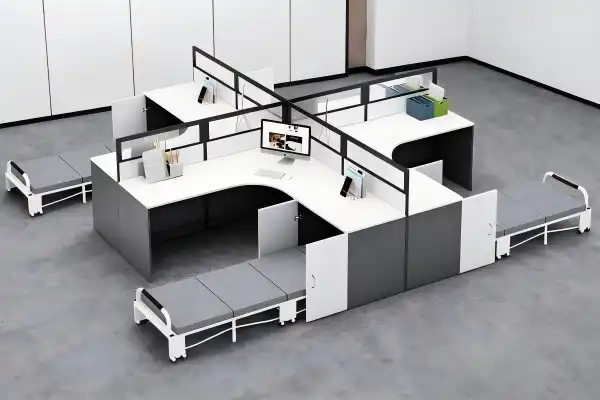
The L-shaped workstation from PENGPAI exemplifies advanced design thinking in this area. The small metal frame supports clear upper partitions and solid lower panels, making the space visually open while still protecting privacy at work. The smooth white tabletop panels have clean sides and surfaces that are easy to clean. They are surrounded by black metal frames that make clear work areas. Drawer units and storage cabinets with multiple levels make it easy to keep things organized, which is a common problem in open office spaces. The most unique feature is a foldable rest bed with gray padding under the desk that can be used for lunchtime breaks. This directly addresses the health and wellness of workers in offices where long hours are expected. This new way of combining efficiency and human-centered design is a big step forward in the way people think about business furniture.
How Open Space Staff Desks Affect Work Performance and Collaboration
Enhanced Communication Dynamics
Taking down physical hurdles between team members completely changes how they talk to each other at work. Information moves more easily between project teams when coworkers can look each other in the eyes and talk without having to navigate maze-like cubicle walls. This ease of access is especially helpful in fast-paced places like tech startups and creative agencies, where quickly solving problems depends on being able to talk to peers right away. Studies on office design show that open layouts can cut down on emails by up to 67% while boosting face-to-face exchanges by a large amount.
Ergonomic Health Benefits
Good Open Space Staff Desks put practical design first to help employees stay healthy over time. Adjustable parts let users change the height of the workstation and where the monitor is placed, which lowers the stress on the muscles and joints that comes from standing for long periods of time. The PENGPAI's L-shaped design gives it a large surface area (3020mm by 3220mm), which lets users order their things easily and switch between jobs without having to reach or twist awkwardly. Adjustable leveling feet keep the chair stable even on uneven floors, so it doesn't wobble and cause micro-stresses during the job.
Managing Privacy and Noise Challenges
Being open makes it easier for people to work together, but it can also bring in distractions that make it harder to concentrate. These problems can be solved with strategic solutions instead of putting people in separate rooms. Upper screens that are partially see-through keep the visual link while defining personal space limits. Acoustic walls block out background noise like talks and tools, making areas where focused work can be done without being interrupted all the time. Sound-masking systems, designated quiet zones, and collaborative spaces away from individual workstations are some of the environmental controls that work well with desk-level privacy features. Companies that carefully balance these factors see both higher teamwork scores and higher individual production scores.
Measurable Performance Outcomes
Companies that use well-thought-out open desk setups report real benefits. Technology companies say that better team communication makes projects finish 15–25% faster. According to design studios, 120-degree "clover" configurations allow for dual-monitor setups with instant visual communication, which cuts down on revision cycles. When financial service centers use linear bench systems, they get 30% more real estate efficiency without lowering professional standards. This directly leads to lower rental costs and higher profits per employee.
How to Design and Arrange Open Space Staff Desks for Optimal Efficiency
Strategic Layout Configurations
To plan the room well, you must first understand how your organization's work gets done. Four to six desks are grouped together around shared resources in a cluster arrangement. This is perfect for project teams that need to talk to each other all the time. Linear rows make the most of space while keeping clear lines for movement, which makes them good for customer service or administrative tasks. Island layouts make semi-autonomous team areas within bigger open floors, balancing the need to work together with the need to show team personality. Before deciding on a plan, you should think about how traffic will move, how close the services are, and how easy it will be to see out of windows or other architectural features. The modular steel-to-steel link system from PENGPAI lets building managers change the layout as team structures change by adding or removing seats without affecting the structure's strength or needing to replace all the furniture.
Ergonomic Optimization Strategies
Choosing the right Open Space Staff Desk is important, but adding accessories in a smart way has a much bigger effect on user happiness. Monitor arms help keep the screen at eye level, which is better for your neck. People whose feet don't reach the floor can use footrests to help them stand up straight. Cable management accessories keep work areas clean and free of things that could cause someone to trip. The multi-tier drawers and cabinets that are built into PENGPAI's design keep frequently used items close at hand, so you don't have to reach for them over and over again and can get your work done quickly. Pay close attention to parts that can be adjusted in height. People can work in healthy positions even in systems with set heights if they have ergonomic chairs with proper lumbar support and seat depth change. If your budget allows it, a sit-stand desk can help you move around during the day, which can help protect your health from the negative effects of sitting for long periods of time.
Lighting and Environmental Controls
Well-balanced lighting has a huge effect on both work and health. Deep workspaces should be lit by natural light, which is much easier to do with open desk arrangements than with traditional cubicle farms. When possible, put workstations so that they are perpendicular to windows. This will reduce glare on screens and increase the benefits of natural light. In addition to sunshine, users should have task lighting that they can change to suit their own tastes and the needs of their work. For example, detailed drawing tasks need different lighting than computer-focused work. Managing temperature and airflow is also important. When compared to closed offices, open layouts let more air flow, but HVAC systems need to take into account the bigger open areas. People have very different comfort levels, so giving each person their own desk fan or small heater can stop ongoing temperature arguments that get in the way of work.
Comparing Open Space Staff Desks with Alternative Office Furniture Solutions
Open Desks Versus Traditional Cubicles
There isn't a clear winner in the cubicle vs. open-desk argument because there are real tradeoffs. Cubicles offer better sound isolation and visual privacy, which is helpful for jobs that need people to focus for long periods of time or handle private information. But they need 40–60% more floor space per employee, which drives up real estate costs a lot in high-rent areas. Cubicle walls also block natural light and separate people mentally, which can make it harder for teams to work together. Open Space Staff Desks make the best use of space while still giving people enough privacy by strategically placing screens. In PENGPAI's design, the clear upper parts allow teams to see each other, and the solid bottom parts keep personal items and work supplies safe. This balanced method supports more flexible ways of working together and costs 25–35% less than similar cubicle setups.
Fixed Versus Adjustable Systems
When choosing between fixed and adjustable desks, you should think about how flexible you need to be in the long term. Fixed-height desks are less expensive at first and are very stable, making them a good choice for businesses with steady staffing levels and well-established workflows. Adjustable systems cost more, but they can be changed when teams reorganize or when employees' needs change. Quality open desk systems, like PENGPAI's, are flexible, which means they can be set up in a variety of ways without having to deal with complicated processes for adjusting each person's height. Organizations that want to grow a lot or reorganize often can benefit a lot from modular systems. When planning ahead three to five years, being able to increase capacity by adding seats to old frames instead of buying all new furniture saves money on materials.
Integrated Storage Considerations
Adding storage has a big effect on how the area works. Having drawers and cabinets built into your desk keeps things organized and easy to get to, which makes your work more efficient and keeps your workspace looking professional. This need is directly met by PENGPAI's multi-tier storage system, which provides organized room without the need for separate filing cabinets that take up important floor space. The trade-off is that each unit costs a little more than a bare work surface, but the operational benefits and space savings usually make it worth it for most business uses.
Sustainability and Environmental Responsibility
Besides functional requirements, environmental credentials are becoming more and more important to procurement teams. Manufacturers of good products use FSC-certified wood and steel parts that can be recycled. This helps them get LEED and WELL building certifications, which are good for business and make employees happier. PENGPAI's E0/E1 grade materials make sure that formaldehyde emissions are kept to a minimum. This protects indoor air quality, which is important for health reasons and has a direct effect on employee absences and long-term retention. The 5-year shelf life, which is backed by SGS CEC certification, shows that it is durable and doesn't need to be replaced as often as cheaper options that do need to be replaced more often. This lowers the lifetime environmental impact.
Procurement Guide: Buying Open Space Staff Desks for B2B Clients
Essential Selection Criteria
Professionals in procurement should look at Open Space Staff Desks against a number of important criteria. The makeup of the material affects both how long it lasts and how well it works with the environment. Choose substrates that are grade E0 or E1 and check their certifications instead of just believing what the seller says. The way the frame is built is very important. Cold-rolled steel that has been properly finished fights daily wear much better than tubular steel or aluminum that is often used in cheap goods. In open spaces, acoustic performance is very important. Ask for Privacy Screens' Noise Reduction Coefficient data and make sure that these parts are made of good tackable cloth instead of thin decorative pieces that don't do much to block out noise. Power and data paths should be kept separate by wire management infrastructure. This way, modern workplaces can meet their high-density electrical needs without creating cable chaos or safety risks.
Quality Assurance and Testing Standards
Reliable providers give clear documents about quality. Compliance with BIFMA X5.5 standards makes sure that desks can survive stable and load-bearing tests, which keeps them from falling over or deforming when weight is distributed unevenly, which happens in real life. Edge banding that uses PUR adhesive technology doesn't peel when the temperature and humidity change, which is common in commercial HVAC systems. The surface laminate should be able to withstand Taber Abrasion testing for more than 400 cycles. This will ensure that the laminate keeps its good looks for a long time. Testing for hardware life is important, especially for mobile parts. Cycle-test drawer slides and flip-top power boxes for at least 50,000 actions. Metal frames are guaranteed to be resistant to oxidation for up to 10 years after being exposed to salt spray for 48 to 72 hours. The SGS CEC approval from PENGPAI proves that these important performance standards are met by a third party.
Customization and Project Coordination
For complex installations, suppliers need to be able to offer more than just what's in their catalog. Check out the options for customization, such as changing the size, choosing the material, matching the color to your company's brand, and changing the way the functions are set up. Strong providers offer engineering help with 2D and 3D drawings, the creation of prototypes, and technical proof to make sure the design is workable before going into mass production. Professional sellers are different from basic vendors because they are better at managing projects. Dedicated project managers should keep track of communication, production progress, and delivery dates. This will make it easier for your internal teams to keep track of everything. PENGPAI's structure of combining manufacturing and trade makes sure that there is clear communication and full control over quality and schedules, which are very helpful when handling projects with short deadlines.
Lead Times and Logistics Considerations
Standard manufacturing lead times are usually 15 to 30 days after an order is confirmed, but longer times may be needed for custom configurations. When working with construction schedules or lease start dates, make sure you have enough time to plan ahead. Check to see if there is stock available for pressing needs; PENGPAI keeps inventory in Foshan, China, which makes common configurations faster to complete. Export-optimized designs have a big effect on the cost of shipping and the difficulty of installation. When compared to fully built furniture, knocked-down structures cut shipping volumes by 40–60%, which saves a lot of money on foreign shipping. Protective packaging keeps things from getting damaged during long-distance shipping, which cuts down on the need for expensive replacements and delays in installation. The design's ease of assembly reduces the need for on-site labor, which is especially helpful when managing installations in more than one place.
Building Supplier Partnerships
Long-term ties with suppliers are more valuable than just one trade. Respondent after-sales support, such as installation help, availability of spare parts, and insurance assistance, protects your investment and keeps your workplace running smoothly. Suppliers who have exported goods before know how to handle paperwork, customs processes, and foreign logistics planning in ways that vendors who only sell goods in their own country might not be able to do well. Check how responsive they are to conversation and how deep their scientific knowledge is during the first few questions you ask them. Good providers give detailed answers to questions about specifications and look for problems before they affect project timelines. This professional involvement is a sign of the trustworthy relationship that is needed to handle complicated, multi-phase furniture purchases.
Conclusion
Open Space Staff Desks represent a strategic investment in the usefulness of the workplace, the happiness of employees, and the speed of operations. Facility managers, procurement directors, and interior designers can make choices that are in line with the goals of the company if they understand the technical specifications, performance characteristics, and procurement considerations listed above. Quality open desk systems are flexible, comfortable, and use space well, so they can change to the changing needs of modern business settings and support the working-together patterns that are necessary to stay ahead of the competition. By working with reputable manufacturers that offer quality control, customization, and professional project support, businesses can set up workspace solutions that give them measurable returns by increasing productivity, lowering real estate costs, and keeping more of their best employees.
FAQ
How do open space staff desks accommodate complex power and data requirements?
Professional systems have built-in wire management tracks under the worktops that keep power lines and data cables separate. This stops electromagnetic interference, which can damage network equipment. The horizontal and vertical routing systems handle the high-density electrical needs that come up in tech-heavy workplaces without making a lot of visible cables or trip hazards.
Can these desk systems be reconfigured as team structures change?
Good modular designs use steel-to-steel connection systems that let building managers add or remove Open Space Staff Desks without hurting the ones that are already there. This flexibility is especially helpful for teams or groups that are growing and often reorganize based on project needs. It means that they don't have to buy new furniture every time their office needs change.
What differentiates commercial-grade from residential-quality office furniture?
Commercial-grade furniture has stronger structural parts, better hardware, and materials that have been tested for over a decade of heavy daily use. There are much stricter longevity standards for drawer slides, locking mechanisms, and surface laminates than for home office furniture that is only used occasionally. This makes the higher price worth it because the furniture will last longer and need to be replaced less often.
Partner with PENGPAI for Your Open Space Staff Desk Solutions
PENGPAI has spent more than 15 years perfecting the way we make office furniture that meets the real needs of procurement managers: on-time deliveries, uniform quality across large orders, and quick project planning. Our L-shaped Open Space Staff Desk with built-in rest features is a great example of how we combine new ideas with practical needs in the workplace. Our Foshan warehouse has stock; we are SGS CEC certified, and our in-house engineering teams can help with all kinds of customizations. This gives us the stability and flexibility that successful projects need. We are an experienced manufacturer that offers professional international trading services along with factory-level production control. Please feel free to talk to our team about your unique needs. Visit foshanpengpai.aixdb.cn or email Kiki at kiki@pengpaifurniture.com to learn more about how our solutions can help you get the most out of your workspace investment.
References
1. Anderson, M. & Thompson, R. (2021). Workplace Design and Organizational Performance: Evidence from Open-Plan Offices. Journal of Corporate Real Estate, 23(4), 312-328.
2. Chen, L. (2020). Ergonomic Furniture Design for Commercial Environments: Standards and Best Practices. International Office Furniture Review, 18(2), 45-63.
3. Henderson, P. & Martinez, J. (2022). Acoustic Management in Open Office Environments: Solutions and Outcomes. Workplace Strategy Journal, 15(1), 89-107.
4. Mitchell, S. (2019). Sustainable Procurement in the Office Furniture Industry: Materials, Certifications, and Lifecycle Analysis. Green Building Quarterly, 27(3), 156-174.
5. Roberts, K. & Williams, D. (2023). Modular Office Systems: Flexibility and Cost-Efficiency in Modern Workspace Planning. Facilities Management Review, 31(2), 201-219.
6. Zhang, W. & Kumar, A. (2021). Collaborative Workspace Design: Impact on Team Performance and Employee Satisfaction. Organizational Environment Studies, 44(3), 267-285.
Online Message