
Jul 17, 2026
What is an Open Space Staff Desk? A Guide to Modern Workspaces
An Open Space Staff Desk is a modular workstation system designed for offices with a lot of people working together, where freedom, speed, and staff health all come together. In contrast to enclosed cubicles, these desks have shared structural frameworks with minimal privacy dividers. This makes the best use of floor space while still encouraging individual productivity. Modern versions often come with built-in cord management, comfortable adjustments, and new features like places to store things or rest. These workstations solve important business problems like crowded spaces, complicated technology integration, and employee burnout by encouraging natural light flow, casual collaboration, and human-centered design principles that are necessary for running a competitive business.
Understanding Open Space Staff Desks: Definition and Evolution
From Cubicles to Collaborative Zones
The change from traditional cubicles to open workspaces shows how business priorities have changed over the last 20 years. Companies knew that strict, closed plans made it hard to communicate and took up too much space. Open Space Staff Desks were created as useful solutions. They use bench-style layouts and low-profile walls to keep personal spaces while still allowing team members to talk to each other. This change sped up in the tech and creative industries, where quick project changes needed adaptable furniture arrangements that could grow with changing workforces.
Core Components and Technical Specifications
Modern Open Space Staff Desks are made up of a number of designed parts. The surface of the desk is usually made of high-pressure laminate or melamine-faced wood that meets E0 or E1 environmental standards. This makes sure that there are low formaldehyde emissions, which is important for buying things that are good for your health. Electrostatic powder coatings on cold-rolled steel frames keep them stable and scratch-proof. Acoustic cloth screens with noise reduction factors above 0.5 keep the view clear while blocking out noise. Wire management bins keep power and data cords separate, which stops electromagnetic interference and keeps things looking neat. When looking for furniture for big business projects that need the same quality for all orders, these technical factors are very important.
Innovations Shaping Today's Designs
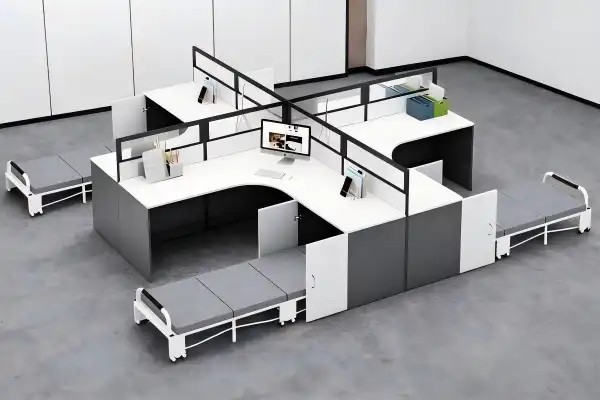
Modern Open Space Staff Desks have multiple uses, which is good for people who work long hours. This change can be seen in PENGPAI's L-shaped workstation, which has a black metal frame with clear upper panels and solid lower panels that keep you private without isolating you. The white laminate desktop has multi-tiered drawer units and storage boxes. There is also a unique foldable rest bed under the work surface that can be extended for lunchtime breaks to help employees stay healthy. This model, which is 3020 x 3220 x 1100 mm and has SGS CEC certification, shows how makers respond to purchasing managers who want solutions that are durable, useful, and human-centered.
Benefits of Open Space Staff Desks for Businesses
Enhanced Collaboration and Communication
Open layouts naturally make it easier for team members to talk to each other and share what they know. When employees can see each other without having to navigate hallways that look like mazes, they can solve problems faster and work together better on projects. According to research from workplace strategy firms, companies that use open configurations make decisions faster and depend less on email. Transparency in these settings helps teams work together, which is especially helpful in engineering and design studios where working together across departments leads to new ideas.
Ergonomic Features Supporting Health
Commercial-grade Open Space Staff Desks are designed to be more ergonomic, which lowers the risk of injuries at work. Different body types and job needs can be met by height-adjustable mechanisms that let you switch between sitting and standing situations to discourage sedentary behaviour. Work surfaces that are the right size keep you from having to reach awkwardly, and built-in cable management keeps you from tripping. The acoustic panels lower the stress of background noise, which helps people concentrate on tasks that require a lot of attention. These health-supporting features have measurable benefits for facility managers who keep track of workers' compensation costs and absenteeism rates for large groups of employees.
Cost Efficiency Through Space Optimization
When compared to standard offices, open space systems make better use of the room. Bench arrangements let more people work in the same space without making things too crowded. When teams grow or shrink, modular components let you rearrange them, so you don't have to buy new furniture when your organization changes. Commercial-grade materials like strengthened steel, wear-resistant laminates, and high-cycle drawer slides make sure that the furniture lasts longer than five years, which lowers the total cost of ownership. When trying to explain capital spending to people who have money, procurement heads who are in charge of office portfolios like these economic benefits.
Designing and Laying Out Open Space Staff Desk Workspaces
Balancing Openness with Privacy Needs
A good open office design takes into account both the need to work together and the need to focus. By placing acoustic partitions in a smart way, you can make semi-private areas for tasks that need long-term focus while still allowing people to see through and keeping the atmosphere open. The PENGPAI workstation's clear upper screens show this balance by letting natural light in while still providing visual boundaries. Planners of layouts should set aside quiet areas away from areas with a lot of foot traffic and include joint places close to shared resources. Different types of workers can use combined furniture systems with this zoning method.
Aesthetic Trends Aligning with Corporate Identity
Minimalist design styles are used in modern Open Space Staff Desks to match modern architectural settings. Black and white colour schemes are popular right now because they look professional and don't draw attention to themselves, which lets design features stand out. Having smooth, clean edges and lines makes big installations look like they belong together, which is important for keeping the look of business offices consistent. More and more, interior designers are choosing furniture that can also be used to define space. For example, desk arrangements and partition heights can be used to subtly separate departments without using physical walls.
Ergonomic Best Practices and Spacing Guidelines
Industry standards say that there should be at least 1200 mm of space between facing workstations to allow for easy movement and escape in case of an emergency. Desktop levels between 600 and 800 mm let you use two computers and handle documents without going too far. Levelling feet that can be adjusted can even out uneven floors so that the desk doesn't wobble and distract users. Placing lights above workstations in the right way cuts down on screen glare, and task lighting options make it easier to read documents. These standards help project planners and building managers make safe, comfortable workplaces that follow the rules for occupational health in different areas.
Comparing Open Space Staff Desks to Alternative Workspace Solutions
Open Plans Versus Traditional Cubicles
When people argue about open vs. closed workspaces, they mostly talk about culture, cost, and productivity. Cubicles provide sound and visual separation, which is helpful in places with a lot of calls, like customer service centers. Open Space Staff Desks lower the cost of building, make space more flexible, and encourage cultures of working together. The choice depends on the business needs. For example, open plans let information flow quickly through financial trading floors, while legal offices may value privacy over open plans. When procurement teams understand these trade-offs, they can make sure that furniture purchases are in line with business models.
Fixed Versus Height-Adjustable Configurations
Height-adjustable desks are more expensive, but they are worth it for knowledge workers who spend a lot of time in front of a screen. Fixed-height systems work well for projects that need to stay within a budget or for jobs that require a lot of moving away from desks. The PENGPAI L-shaped workstation has a fixed structure with built-in storage and rest areas. It is designed for places where versatility is more important than adaptability. When deciding between these options, procurement managers should look at the types of people who work for the company and the tasks that need to be done. Making the wrong choice can affect both employee happiness and utilisation rates.
Storage-Integrated Models Versus Minimalist Designs
Workstations with drawer units and cabinets solve the problem of desk clutter that always comes up in jobs that involve a lot of paperwork. With these integrated solutions, you don't need separate filing cabinets. This frees up space on the floor and makes sure that resources are always close at hand. Minimalist designs with under-desk movement work well in digital-first workplaces where there isn't much need to store documents. Multi-tier storage is part of PENGPAI's offering because they know that many businesses still use both paper and digital workflows, so they need hybrid solutions that can adapt to changing ways of working.
Purchasing and Procurement Guide for Open Space Staff Desks
Decision Criteria for Procurement Teams
Choosing the right furniture for an open space means looking at a lot of different factors. The best way to use available space depends on the size of the office and whether straight, L-shaped, or cluster layouts work best. Material grades and features can be limited by budget, but sacrificing durability often leads to higher replacement costs. Ergonomic needs rely on the type of workers and how hard the work is. For example, design studios need bigger areas for multiple computers, while administrative teams put storage space first. Manufacturers that offer customisation services that let project managers change sizes, materials, and useful parts without making production more complicated are helpful for project managers who are in charge of organising these factors.
Pricing Transparency and Bulk Order Benefits
The price of commercial furniture depends on the type of material, the level of customisation, and the number of items ordered. Standard configurations from well-known suppliers usually cost between a moderate and a high amount per workstation, with discounts starting at fifty units. When you buy in bulk for whole office fit-outs, you can save even more money because production runs are shortened and shipping is combined. Transparent sellers give thorough quotes that break down the costs of materials, labour, finishing, and shipping. This helps procurement directors deal well. PENGPAI keeps stock at their warehouse in Foshan, which cuts down on lead times for standard models and allows for customisation to meet the needs of specific projects.
Order Process and Implementation Support
Professional office furniture suppliers set up clear steps for the buying process. Initial talks figure out what needs to be done and come up with basic quotes. For plan approval, design teams make 2D and 3D models that include technical drawings that show how the product can be made. Before mass production starts, sample proof makes sure that standards are met and production capabilities are understood. Following ISO 9001 standards, production times for custom orders are usually between 15 and 30 days, with quality checks happening when materials are received, during production, and before shipping. To make sure the schedule stays on track, dedicated project managers keep track of communication, track milestones, and deal with problems before they happen.
Sustainability Considerations and Certifications
Demand for environmentally certified furniture is being driven by rising corporate responsibility rules. FSC-certified wood sources and steel parts that can be recycled help LEED and WELL building standards, which are becoming more and more important in government and educational projects. Low-emission laminates that meet E0 standards help with indoor air quality issues. This is especially important in schools and hospitals. Instead of just believing what the manufacturer says, procurement teams should check third-party certifications like SGS. The certified models from PENGPAI have a five-year shelf life, which shows that they last a long time and don't need to be replaced as often, which is an important sustainability factor that is often missed in lifecycle assessments.
Conclusion
Open Space Staff Desks are smart investments in the efficiency of the workplace, the health and happiness of employees, and the ability to change how things are run. These modular systems make the best use of space, balance privacy and teamwork, and can be changed to meet the changing needs of a company. The technical details, like material safety certifications and ergonomic measurements, have a direct effect on how well something works in commercial settings over time. New features, like built-in rest areas, take into account how hard work is in the modern world and support human-centered workplace tactics. To be successful at procurement, you need to compare configurations to specific practical situations, make sure that quality is consistent across large orders, and work with makers that offer customisation options and reliable project management during implementation.
FAQ
How do Open Space Staff Desks handle the complicated power needs of high-tech settings?
Professional systems have built-in wire management tracks under the worktops that keep power lines and data cables away from each other. This stops electromagnetic interference, which is very important for IT operations. When technology changes, horizontal cable trays with covers that can be taken off make it easy to rearrange, and vertical cable snakes keep wires from tripping over things while they're being moved from the desk to the floor.
Can these workstations be rearranged if the number of people on the team changes?
Modular steel-to-steel connections let building managers add or remove workstation sections without affecting the structure's strength. This adaptability is very important for companies that are still growing or project-based ones whose space needs change every three months. Most of the time, in-house repair teams don't need special tools to take things apart and put them back together again.
What lead times should procurement managers expect for bulk orders?
Standard configurations that are in stock can be shipped within days. Customised projects, on the other hand, usually take 15 to 30 days from the time the order is confirmed until they are finished being made. Customisations that are very complicated, like having unique sizes or finishes, may make the process take longer. During the quote phase, reputable suppliers give detailed production plans that help project managers time the delivery of furniture with important building milestones.
Partner with PENGPAI for Your Open Space Staff Desk Solutions
Picking the right Open Space Staff Desk maker can affect the success of a project, from making sure the design works to making sure the desk lasts for a long time. PENGPAI offers professional international trading services along with factory-level production control. This makes sure that communication is reliable and quality is consistent across large orders. Our integrated production model allows for flexible customisation, such as changing the size, choosing the material, and changing how it works. Our engineering teams provide detailed plans and make sure the changes are possible. The L-shaped workstation with its cleverly integrated rest bed shows how we're dedicated to using thoughtful design to solve real problems in the workplace. With our SGS CEC certification, E1-compliant materials, and ready-to-ship inventory at our Foshan plant, we give global procurement teams the production security and export efficiency they need. Get in touch with our team at kiki@pengpaifurniture.com to talk about the details of your project and find out why top commercial contractors trust PENGPAI as their Open Space Staff Desk supplier.
References
1. American Society of Interior Designers. (2019). Impact of Design: Workplace Productivity and Performance Standards. Washington: ASID Publications.
2. Becker, F., & Steele, F. (2020). Workplace Strategy: Environment as a Tool for Work Performance. Boston: Harvard Business Review Press.
3. International Facility Management Association. (2021). Space Planning and Management Guidelines for Commercial Environments. Houston: IFMA Research Foundation.
4. Kim, J., & de Dear, R. (2018). "Workspace satisfaction and collaborative work environments: Comparative analysis of open-plan configurations." Building and Environment Journal, 145, 234-248.
5. Sander, E., & Miller, P. (2022). Ergonomic Furniture Standards in Corporate Procurement: Technical Requirements and Compliance. New York: Commercial Design Institute.
6. World Green Building Council. (2020). Health, Wellbeing and Productivity in Offices: International Research Review on Environmental Certification Standards. London: WGBC Publications.
Online Message