
Jun 29, 2026
Office Staff Desk Table Design: 10 Space-Saving Ideas for Small Offices
As the cost of business real estate in the US keeps going up, making the most of every square foot of office space stops being a design choice and becomes a strategic requirement. This problem is directly addressed by space-saving desk designs that provide useful workstations that are still ergonomic without lowering output. A well-designed Office Staff Desk Table can turn a small amount of floor space into a clean, organized place for people to work together, where people can focus on their tasks, and companies can get the most out of the money they spend on office furniture.
Understanding Office Staff Desk Tables for Small Spaces
What Defines an Effective Staff Desk for Compact Environments
There is a big difference between a small Office Staff Desk Table and a standard cubicle system or a large senior workstation. These desks focus on small areas while still providing necessary workspace, storage, and natural alignment. The main purpose stays the same: to provide a stable, comfy surface for focused work. However, the engineering moves toward vertical storage integration, flexible components, and knock-down construction, which makes installation easier in limited spaces.
Core Benefits of Space-Saving Desk Solutions
Procurement managers in charge of business projects can measure the benefits of smart desk design that makes the most of useful office space. A smaller size means lower rent costs per employee, and more open room for moving around makes the workplace safer and easier to get to. Even if there is limited room, when employees have a good personal workspace, job happiness goes up, and turnover goes down. These desks also support flexible workplace strategies, which means that companies can change setups as team structures change without having to buy all new furniture.
Ergonomic Principles for Compact Workstations
Even though desks are getting smaller, they still need to meet certain design standards to keep workers from getting musculoskeletal problems and to keep them productive. The standard in the industry is still a 750mm work area height, which is good for most people who sit down, but movable leveling feet let you fine-tune for floors that aren't level. The depth of the desk shouldn't go below 600 mm so that you can see your computer clearly and support your forearms. Good materials are very important. For example, E1 grade MFC boards don't get damaged by water and keep their shape even after daily use, and 25mm thick tables keep them from bending when they're holding up multiple monitors and other equipment.
10 Proven Space-Saving Office Staff Desk Table Ideas
Wall-Mounted Floating Desk Systems
Wall-mounted desks don't block the floor at all, giving the impression of more space while still providing full usefulness. Big-duty brackets hold these units directly to solid walls, so they can hold big loads without the need for standard leg frames. Installing it requires careful bolt placement and the right choice of fasteners, but the end result makes the floor more usable for moving around and putting extra furniture away.
Modular Bench-Style Workstations
In bench configurations, multiple workers are positioned along a single work area, sharing center leg supports and power outlets. When compared to individual seats, this method lowers the impact on each employee by about 15% while encouraging them to work together. When the size of a team changes, modular bench systems are easy to adjust because adding or removing pieces doesn't cause too much trouble and doesn't require any special tools.
Corner and L-Shaped Desk Layouts
When L-shaped desks are put in corners that aren't being used, they become useful areas. These designs take up room that is usually empty but make the most of the useful surface area. The uneven surfaces naturally split different ways of working—one leg for computer work, the other for writing or group discussions—without the need for extra furniture.
Desks with Integrated Vertical Storage
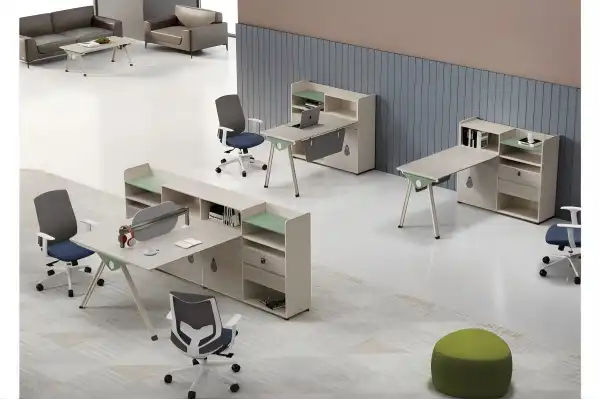
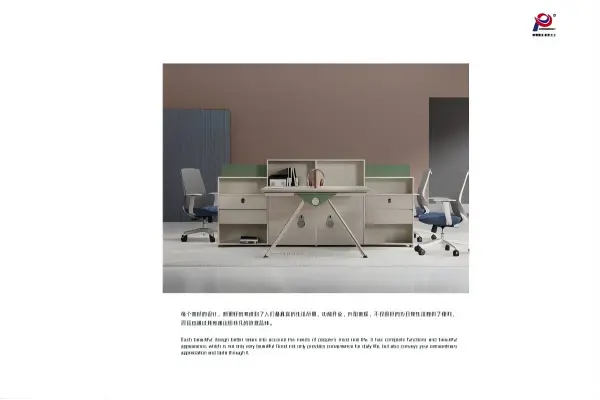
One of the best ways to maximize productivity in a small office is through vertical integration. With overhead shelves, side-mounted books, and desktop hutches built into desk systems, you can keep important things close at hand without taking up extra floor space. This idea is shown by the Office Staff Desk Table that PENGPAI makes. It has a central modular unit with locked drawers, open shelves, and a vertical bookshelf surrounded by accent panels, all in a 2800x2400x750mm space.
Adjustable Height Sit-Stand Desks with Compact Profiles
Height-adjustable desks help employees stay healthy by letting them change their position, and small models offer these benefits without taking up too much space. With electric or manual lift systems built into slim leg frames, work areas can be moved from a seated to a standing position with very little space taken up. When buying a lot of flexible models, make sure to check the load capacity approvals and cycle testing data to make sure they will last under normal business use.
Foldable and Collapsible Desk Solutions
Foldable desk systems that can be stowed against walls when not in use are useful in places that have more than one use during the day. These designs allow training rooms, hot-desking areas, and multi-use zones to quickly change from private workspaces to open floor plans. Good springs and locking mechanisms make sure that the item stays stable while it's being used, and the lightweight makes it easy to use.
Nested and Stackable Desk Components
Smaller secondary surfaces slide under the main tables in nested desk systems. These give you extra room for big projects and a place to put things away when you're not working on them. This way of thinking about design makes the workspace bigger by about 40% when it's needed, without taking up that extra room forever. Procurement teams like how flexible these systems are because they can handle changing tasks and temporary staff growth.
Multi-Tier Desk Platforms with Elevated Monitor Shelves
Multi-tier platforms that use vertical space to organize materials and tools across multiple levels keep the main work area free for busy tasks. Elevated monitor shelves put screens at the best heights for ergonomics and make space below for computers, tablets, and papers. This tiered method works especially well for technical jobs that need to use a lot of screens and other devices.
Mobile Desk Units on Casters
Mobility changes set plans into fluid ones where workers can move their desks to meet immediate needs. Locking wheels make the furniture stable while it's being used and make it easy to move when it needs to be rearranged. Facilities managers like mobile desks because they help keep areas open so that different types of work can be done without having to permanently change the infrastructure.
Minimalist Desks with External Storage Integration
Clean-lined, minimalist Office Staff Desk Table designs keep things simple to look at while still being fully functional, thanks to their compatibility with various mobile storage units. This approach allows companies to standardize Office Staff Desk Table dimensions for a more uniform workspace while still accommodating different storage needs by providing employees with additional filing cabinets and drawer pedestals that can be positioned according to individual preferences.
All of these ideas for saving room are based on engineering that takes into account both human wants and space limitations. When you're looking at project choices, you should think about how each plan fits with your unique operational needs and the way you work.
How to Choose the Best Office Staff Desk Table for Small Offices
Assessing Spatial Constraints and Layout Requirements
Correct spatial research is the first step in making choices about purchases. Not only do you need to measure the floor space you have, but you also need to measure the ceiling height, where the columns will go, and the needed traffic paths. Figure out how many workstations the space needs to have, and then assign a certain amount of square footage to each employee. According to industry standards, each person should have 50 to 75 square feet in open spaces, but good desk design can cut this requirement by 20% without affecting comfort.
Prioritizing Durability and Material Quality
Commercial office furniture is put through a lot more stress than private furniture of the same type. Commercial-grade construction with E1 or E0-rated engineered wood products, reinforced joinery, and powder-coated metal parts that don't rust is needed for desks that serve multiple workers across multiple shifts. Our Office Staff Desk Table is made with E1-grade MFC boards that are good for the environment. The sides are 25 mm thick, and the edges are banded at 1.5 mm. This gives the table a guaranteed 5-year shelf life even after heavy use, and it still meets SGS and CEC standards.
Evaluating Customization Capabilities and Lead Times
Changes to the size, finish, or functionality are often needed because of the needs of a unique project. Suppliers like PENGPAI that can do both design and production can offer customization without long lead times because design changes happen in the same building that does production. This integration gets rid of delays in contact between factories and trade companies. This lowers the risk of the project and makes it easier to stick to the schedule.
Comparing Fixed Versus Adjustable Configurations
Fixed-height desks are good for standard workplaces with regular physical needs because they are cheaper and easier to put together. Adjustable options are better for a variety of employee groups and support health programs by letting people change their position, but they cost more at first. To find the total cost of ownership, you have to compare the extra price to the possible increases in output and lower injury claims.
Understanding Logistics and Installation Complexity
Knock-down construction significantly reduces shipping volume and transportation costs, making it especially advantageous for international procurement of Office Staff Desk Table solutions. Desks with clear assembly instructions minimize installation labor, which is particularly valuable when furnishing multiple floors or buildings simultaneously. Our Office Staff Desk Table products feature metal-to-metal connections and cam-lock fasteners that maintain structural integrity even after repeated disassembly and reassembly. This makes them an ideal choice for organizations that frequently reconfigure their workspace layouts.
Procurement and Maintenance Tips for Office Staff Desk Tables
Strategic Sourcing for Bulk Office Furniture Purchases
When you work directly with manufacturers instead of going through multiple layers of marketing outlets, procurement is much more efficient. When you buy directly from a company, you skip the markups that come from middlemen and get access to engineering teams that can answer your technical questions and make changes to your order. Building connections with suppliers who keep ready stock, like PENGPAI's inventory in its Foshan warehouse, speeds up project delivery and lowers the risk of supply chain disruptions.
Negotiating Terms and Securing Quality Assurance
When you buy a lot of something, it makes sense to ask for sample units to check out in person before committing to full orders. During this step, you will look at the quality of the joinery, the accuracy of the finish, and how well the hardware works. Clear quality standards should be negotiated into buy deals, along with the accepted ranges for size accuracy, color matching, and surface flaws. Make sure you understand what the guarantee covers in terms of structural breakdowns, finish wear, and the ability to get new parts.
Material-Specific Maintenance Protocols
Different types of desk materials need different ways of being maintained to make them last as long as possible. MFC surfaces are good at resisting water and stains, but spills need to be cleaned up right away to keep the edge bands from coming apart. Avoid using rough cleaners on these surfaces because they can damage the melamine layer. Instead, use light detergents and microfiber cloths to clean them. Fasteners and adjustment mechanisms in metal frames should be checked and lightly oiled on a regular basis to keep them running smoothly. Set maintenance plans that are in line with how often the space is used. For example, areas with a lot of foot traffic should have checks every three months, while standard offices can get by with yearly reviews.
Avoiding Common Procurement Pitfalls
When you shop based on price, ignoring environmental compliance can cost you in the long run by lowering your efficiency and putting you at risk of being sued. Also, not checking the building requirements before placing an order can lead to unexpected work costs if specific skills or tools are needed. Carefully read the guarantee terms and make note of the exclusions for normal wear and tear, abuse, or illegal changes. During the installation and early use phases, procurement managers should also make sure that the seller is responsive and has a good support system. This is because questions will come up after the purchase.
These things to think about when buying and maintaining furniture will protect your investment and make sure that the area continues to support your organization's goals for as long as the product is in use. Facilities teams that know how to do proper upkeep can greatly increase the time between replacements, which improves total cost performance.
Conclusion
Making desks that take up less room is a practical way to deal with the ongoing problem of creating productive workplaces within limited commercial spaces. Whether selecting a compact Office Staff Desk Table or implementing a complete workspace redesign, the ten ideas discussed here range from wall-mounted systems that maximize floor space to modular setups that improve team collaboration. Each solution addresses different functional and spatial requirements. Successful implementation requires a thorough analysis of the available space, a clear prioritization of organizational needs, and partnerships with suppliers capable of delivering consistent quality for large-scale orders. By balancing ergonomic standards with space efficiency, procurement professionals can use the right Office Staff Desk Table solutions to create environments where employees can perform at their best despite space constraints, maximizing real estate value while maintaining employee satisfaction.
FAQ
What are the standard desk dimensions suitable for small office environments?
Most small office desks are 1200 to 1400 mm wide, 600 to 700 mm deep, and 750 mm tall. These measurements make for a good work area for computer work and writing, and they also work well in tight spaces. Larger modular systems, like PENGPAI's 2800x2400mm layout, can accommodate more than one worker and include built-in storage that would normally need its own furniture pieces.
Are adjustable desks cost-effective for small office projects?
Adjustable desks are 30–50% more expensive at first than fixed desks, but companies that care about their employees' health and want to accommodate different body types often find the extra cost well worth it because of higher employee happiness and fewer environmental complaints. Instead of just looking at the purchase price, figure out how cost-effective something is by estimating how long it will be used and how much it could help production.
How can ergonomic principles be maintained in compact desk designs?
Maintaining good ergonomics means keeping the right level of the work area so that the monitor can be placed at arm's length, making sure that the average user's work height is 750 mm, and adding adjustable parts whenever possible. These standards are met by compact designs that don't just reduce desk sizes proportionally, but also incorporate vertical storage and efficient component arrangement.
Partner with PENGPAI for Your Office Furniture Needs
PENGPAI is both a manufacturer and a trading business. This means that procurement managers have direct access to both production skills and skilled export services. Our Office Staff Desk Table collection is made to fit the needs of small offices with flexible designs, long-lasting E1 grade MFC construction, and the ability to be customized with the help of our own engineering teams. We make the buying process easier from the first question to the installation by having ready-to-ship items in our Foshan warehouse, offering 5-year warranties on our products, and providing full project management support. You can email our team at kiki@pengpaifurniture.com to talk about your needs for space-saving furniture, get detailed models, or set up an evaluation sample. We have been in the business for a long time and supply Office Staff Desk Tables to government agencies, corporate offices, and commercial contractors all over the world. We know how important it is to keep your project on schedule and on budget by providing consistent quality, reliable delivery dates, and quick communication.
References
1. Anderson, M. (2022). Ergonomic Design Standards for Contemporary Office Furniture. Workplace Research Institute.
2. Collins, R., & Martinez, S. (2023). Space Optimization Strategies in Commercial Real Estate. Journal of Facility Management, 41(3), 215-234.
3. Henderson, J. (2021). Material Science in Office Furniture Manufacturing. Industrial Design Quarterly, 28(2), 112-128.
4. Thompson, K. (2023). Procurement Best Practices for Commercial Furniture Projects. Supply Chain Management Review, 19(4), 87-103.
5. Williams, P., & Chen, L. (2022). Modular Workspace Solutions: Design and Implementation. Architecture and Planning Journal, 36(1), 45-67.
6. Zhang, H. (2023). Sustainable Materials in Office Environments: Health and Performance Impacts. Environmental Design Research, 15(2), 156-178.
Online Message