
Aug 4, 2026
Linear Office Staff Desk Designs Support Modern Employee Workstations
Modern workplace design has transformed significantly over the past decade, driven by evolving employee needs and organizational efficiency goals. The Linear Office Staff Desk represents a fundamental shift toward streamlined, collaborative workspaces that balance individual productivity with team interaction. These straight-line configurations eliminate wasted floor space while providing ergonomic comfort and functional flexibility. Unlike traditional cubicles or isolated desking arrangements, linear workstations create visual openness and facilitate communication without sacrificing personal workspace integrity. This design philosophy addresses real commercial challenges: space optimization in expensive real estate markets, adaptability for growing teams, and durability standards that withstand daily professional use across diverse industries.

Understanding Linear Office Staff Desks: Core Features and Practical Benefits
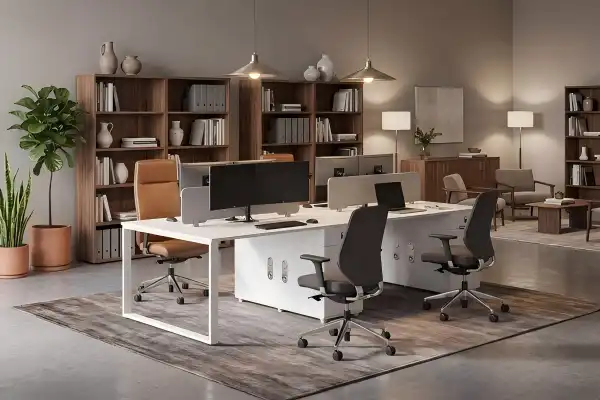
Linear Office Staff Desk systems are based on a simple geometric principle: they line up work surfaces in straight rows to make the most usable space in rectangular floor plans. This way of doing things is very different from L-shaped or radial configurations that waste corner room.
Material Engineering and Environmental Standards
Modern Linear Office Staff Desks are made of advanced composite materials that are designed to last in the business world. The 25mm Moon Tree national standard E0 grade panels in our Linear Office Staff Desk are made of an odorless, eco-friendly board that meets or exceeds European formaldehyde emission guidelines. The surface is edged with 2mm PUR, which seals the edges and stops moisture from getting in, which stops the particle board from breaking down. This building method solves a common problem in purchasing: making sure that the quality of samples matches the quality of bulk production. With the E0 certification, formaldehyde levels stay below 0.5 mg/L, which meets LEED requirements for indoor air quality and protects workers' health in closed offices.
The structure is made of 1.5 mm cold-rolled steel tubing that is 30x60 mm in size and is powder-coated to keep it from rusting. This metal-to-panel ratio lets the structure hold up to 100 kg of evenly spread weight while still looking light. The white steel frame makes you feel like you have more space, which is important in open-plan spaces where visual clutter can make it hard to focus and reduce stress.
Ergonomic Integration and Functional Accessories
Not only do adjustable chairs fall under ergonomic design, but so does the whole workstation ecosystem. Our Linear Office Staff Desk layout has see-through frosted screens with dark top edges. Soundproof fabric baffles reduce noise while keeping clear lines of sight for supervisory control. These walls are precisely measured to balance privacy and teamwork, meeting the needs of both focused work and team interaction.
In offices that depend on technology, cable management infrastructure is a key differentiator. The middle leg has an 86-type cable box hole—a common hole for power outlets and data lines that doesn't need to be drilled into the desk. USB cable pass-through covers keep desktops clean and make charging ports easy to get to. Wiring that gets tangled up is a problem that keeps coming up in high-density office spaces and is hard to keep up; this integrated approach solves the problem.
Mobile storage parts include white three-drawer pedestals with Liansheng silent three-section slides that are 37 mm wider and thicker. These industrial-grade drawer parts have been tested over 50,000 times and have not lost any of their functionality. The patented egg-shaped combination lock from the TT brand keeps personal items safe, and the silent hydraulic soft-close hinges from the Hango brand (backed by a lifetime warranty) keep drawers from slamming, which is important in professional settings that prioritize noise control.
Space Efficiency and Configuration Flexibility
The measurements of 2400x1200x750mm come from a study into the best proportions for a workstation. The 1200mm depth allows for dual-monitor setups with enough space between them to avoid eye strain, and the 750mm height is standard for ergonomic seating. The 2400mm length can accommodate two workers at a bench or give each person plenty of room to work.
Through shared leg systems, modular construction can be expanded after it has been installed. This scalability is liked by procurement managers because it lowers the initial capital costs while keeping the ability to grow. Unlike welded benching systems, knock-down architecture makes shipping cheaper in flat-pack forms, which cuts handling costs by about 40% compared to furniture that is already put together.
Designing Linear Office Desks for Optimal Employee Workstations
To make a good workspace design, you need to know how the physical surroundings affect work happiness and cognitive performance. According to research from the International Facility Management Association, well-designed workstations can boost productivity by 15 to 20 percent while lowering the number of sick days due to musculoskeletal disorders.
Ergonomic Principles in Practice
Three biomechanical factors are taken into account by good workplace ergonomics: supporting posture, encouraging movement, and placing tools correctly. The normal 750mm surface height lets you work while sitting down if you use an adjustable chair and keep your elbows at a 90-degree angle while you type. The center cutout column in our Linear Office Staff Desk design gives you the most space possible, so your thighs don't get squished, which can cause circulation problems when you sit for long periods of time.
The 20-degree rule tells us that the top of the monitor should be at or just below eye level so that your neck doesn't bend forward. The see-through privacy screens are mounted at exact heights that block out distractions from the sides without getting in the way of seeing what's going on around you, which is important for safety and socializing in shared areas.
Collaborative Versus Focused Work Configurations
Workspace psychology makes a distinction between tasks that need to be concentrated (convergent) and tasks that need to be divergent. Creative teams, customer service offices, and project groups that need to share information quickly can benefit from Linear Office Staff Desk configurations with few walls. The open sightlines make it easier for people to talk to each other without being told what to say.
On the other hand, partitioned Linear Office Staff Desk setups are good for accountants, programmers, lawyers, and other jobs that require long-term focus. The soundproof fabric baffles cut down on background noise by 6 to 8 decibels, which is low enough to keep conversations from getting interrupted without blocking out sound. This acoustic engineering solves one of the main problems people have with open offices: the inability to control auditory interruptions.
Case Applications Across Industry Sectors
Technology companies often use benching methods to encourage people to work together and make the most of their limited space. A software company in San Francisco implemented our Linear Office Staff Desks in 2022. Compared to standard cubicles, they allowed 30% more workers to work in the same space. The project manager noted that the integrated cable management eliminated previous frustrations with power access for multiple devices.
Durability and safety approvals are important to government agencies. In 2023, a municipal office renovation chose Linear Office Staff Desk workstations that met BIFMA X5.5 stability standards and had SGS certification for material safety. The five-year shelf life is in line with government furniture replacement cycles, and the E0 environmental grade meets the requirements for sustainable public buying.
Healthcare administrative offices need surfaces that are clean and easy to maintain. The sealed edge banding on our Linear Office Staff Desks keeps germs from hiding in the seams of the particle board, and the powder-coated steel doesn't break down when disinfectants are used on it. A network of clinics in the Midwest bought 15 administrative workstations with a white finish because it looks professional and is easy to clean.
Comparing Linear Office Staff Desks with Alternative Desk Types
When making purchasing choices, you have to compare different types of desks to meet the needs of your organization. In some situations, Linear Office Staff Desk configurations work best, while other shapes are better for certain functional priorities.
Spatial Efficiency Comparison
When employees are seated at a benching arrangement, a Linear Office Staff Desk gives them about 15 to 18 square feet of space. This is the highest density of any professional workspace option. U-shaped desks take up 40 to 50 square feet per person because they take up room in the corners, but they have more surface area for work that involves a lot of documents. L-shaped layouts are in the middle, with 25 to 30 square feet of space per workstation.
In rectangular rooms, corner desks make "dead zones" where furniture can't go because of the angles of the walls. Linear Office Staff Desk methods use full perimeter dimensions to line up parallel to walls. This geometric edge directly saves money on real estate costs in pricey urban markets where lease rates exceed $50 per square foot annually.
Storage and Cable Management Trade-offs
Most U-shaped and L-shaped desks have both overhead storage and lateral file boxes built into their footprints. This built-in capacity suits roles requiring immediate access to physical documents. Linear Office Staff Desk workstations utilize mobile pedestals that store beneath the desktop, preserving legroom while providing portable filing. With its three drawers, the design makes it easy to organize hanging file folders, office supplies, and personal items.
The level of sophistication in managing cables varies by desk type. Vertical power poles and horizontal wire trays are standard on high-end U-shaped desks, but they add 30–40% to the cost per unit. Our Linear Office Staff Desk achieves comparable functionality through strategic cable box placement in shared legs, distributing infrastructure costs across multiple workstations.
Durability and Maintenance Considerations
Commercial-grade furniture endures substantially different use patterns than residential pieces. Office desks experience continuous occupancy, equipment weight, impact from mobile storage units, and cleaning chemical exposure. Instead of putting all the force on a single leg support common in residential designs, the reinforced steel framework in Linear Office Staff Desk systems distributes stress loads across many contact points.
Maintenance accessibility matters in large installations. Linear systems with shared legs require coordinated disassembly for repairs, whereas individual freestanding desks allow isolated maintenance. However, industrial-grade components in properly specified Linear Office Staff Desk workstations rarely require intervention during their service life—our five-year shelf life is based on conservative estimates from accelerated wear testing.
Cost Analysis and Bulk Procurement Advantages
When bought in bulk, entry-level Linear Office Staff Desk units range from $200 to $400 per workstation. Mid-range desks cost between $400 and $700, and top-of-the-line systems exceed $800. These tiers reflect material quality, certification standards, and accessory inclusion. U-shaped desks usually command 60–80% price premiums due to increased material consumption and manufacturing complexity.
Volume pricing structures significantly impact project economics. Orders exceeding 50 units typically receive 15-20% discounts, while projects above 200 units may negotiate 25-30% reductions. Warranty terms extend with volume commitments—standard one-year coverage often expands to three or five years for strategic accounts.
Procurement Guide: Ordering Linear Office Staff Desks for Your Business
Successful furniture procurement requires systematic supplier evaluation, clear specification communication, and realistic timeline planning. Understanding the procurement lifecycle prevents common pitfalls that delay projects and inflate costs.
Supplier Assessment Criteria
Verifying the manufacturing capacity is the first step toward reliability. Integrated manufacturers controlling production facilities offer superior quality consistency compared to trading companies sourcing from multiple subcontractors. Our Foshan facility spans 200,000 square meters with dedicated production lines for panel processing, metal fabrication, and assembly—ensuring batch-to-batch uniformity critical for phased installations.
There is a direct link between export experience and international project success rates. Suppliers familiar with destination country regulations prevent customs clearance delays and non-compliance penalties. Our team navigates BIFMA standards for North American markets, FIRA certification for UK projects, and various ISO requirements for European Union procurement.
Communication infrastructure matters as much as manufacturing capability. Dedicated project managers eliminate the coordination breakdowns that occur when multiple contacts handle different project phases. We assign single points of contact who manage technical queries, production updates, shipping coordination, and after-sales support—streamlining decision-making and accountability.
Customization Process and Engineering Support
Standard product selection suits straightforward requirements, but most commercial projects require adaptation. Customization begins with requirement analysis: understanding spatial constraints, aesthetic preferences, functional priorities, and budget parameters. Our design team provides 2D CAD drawings and 3D renderings that visualize configurations before production commitment.
Technical feasibility validation prevents costly design revisions. Engineering reviews assess whether custom dimensions maintain structural integrity, confirm material availability for specified finishes, and evaluate manufacturing efficiency. This upfront investment reduces the sample-to-production discrepancies that plague projects lacking rigorous design validation.
Prototype development allows physical evaluation before bulk orders. Sample workstations undergo load testing, finish inspection, and assembly verification. Clients assess ergonomic comfort, aesthetic integration with existing interiors, and accessory functionality. This confirmation step provides confidence that mass production will meet expectations—critical for projects where budget constraints prevent do-overs.
Lead Times and Logistics Coordination
Production scheduling depends on order complexity and manufacturing queue depth. Standard configurations from existing inventory ship within 5-7 business days from our Foshan warehouse. Custom specifications require 3-4 weeks for material procurement, fabrication, quality inspection, and packaging. Rush orders accommodate expedited timelines through production priority adjustments, though premium charges typically apply.
Shipping methodology impacts total landed costs and delivery timelines. Sea freight requires 4-6 weeks for North American destinations but costs 70-80% less than air transport. Projects with flexible timelines benefit from ocean shipping, while urgent renovations justify air freight premiums. Knock-down packaging optimizes container utilization—our Linear Office Staff Desks ship in compact cartons that maximize 40-foot container capacity.
Installation and After-Sales Support
Assembly complexity varies across furniture types. Linear Office Staff Desk workstations feature intuitive knock-down construction requiring basic hand tools and minimal technical expertise. We provide illustrated instruction manuals, video tutorials, and technical support hotlines for installation questions. Many clients utilize in-house facility teams rather than hiring specialized installers, reducing project costs.
After-sales service quality determines long-term satisfaction. Warranty coverage should specify response times for defect claims, replacement part availability, and service location. Our support includes installation guidance, spare parts inventory for hardware components, and responsive communication channels. Procurement managers value this ongoing relationship because furniture represents multi-year investments requiring periodic maintenance and potential expansion.
Future Trends and Innovation in Linear Office Desk Designs
Workplace furniture evolution reflects broader societal shifts in work patterns, environmental consciousness, and technology integration. Forward-thinking manufacturers anticipate these trends rather than reacting to established demand.
Sustainability and Material Innovation
Corporate environmental responsibility increasingly influences procurement decisions. Furniture contributes to building LEED certification through material selection, manufacturing processes, and end-of-life recyclability. Our E0 emission panels support indoor air quality credits, while recyclable steel components facilitate responsible disposal.
Emerging materials include bio-based composites incorporating agricultural waste fibers, recycled ocean plastics for edge banding, and low-carbon aluminum extrusions. These innovations maintain performance standards while reducing environmental footprints—appealing to organizations with sustainability mandates and stakeholder reporting requirements.
Smart Technology Integration
Modern workstations evolve into technology hubs beyond passive furniture. Power-equipped surfaces with built-in USB-A and USB-C ports eliminate adapter clutter while providing fast-charging capability. Wireless charging pads embedded in desktop surfaces support mobile devices without cable connections.
Advanced installations incorporate occupancy sensors that integrate with building management systems, optimizing HVAC and lighting based on real-time workspace utilization. This data informs space planning decisions and supports hybrid work policies by tracking desk usage patterns.
Adaptability for Hybrid Work Models
Post-pandemic workplace strategies embrace flexible attendance patterns combining remote and office work. Furniture must accommodate hoteling systems where employees reserve workstations rather than maintaining assigned desks. Linear benching with minimal personalization supports this fluidity while maintaining professional aesthetics.
Height-adjustable mechanisms gain prominence as awareness grows regarding sitting-disease health impacts. Electric lift systems allow seamless transitions between seated and standing work positions, though they increase unit costs by $300-500 per workstation. Budget-conscious alternatives include manual crank adjustments or converter platforms placed atop fixed-height desks.
Conclusion
Linear Office Staff Desk design represents the intersection of ergonomic science, spatial efficiency, and commercial durability. These straightforward configurations address fundamental workplace challenges: maximizing expensive real estate, supporting diverse work styles, and withstanding intensive professional use. Material engineering advances deliver environmental certifications and long-term reliability, while integrated cable management and modular construction provide functional advantages over alternative desk types. Successful procurement requires evaluating supplier manufacturing capacity, communication infrastructure, and after-sales commitment alongside product specifications. Looking forward, sustainability innovations and smart technology integration will define next-generation workstations that adapt to evolving hybrid work patterns while minimizing environmental impact.
FAQ
How does the Linear Office Staff Desk accommodate technology requirements for modern offices?
The integrated cable management system includes 86-type cable box holes in central legs, allowing power and data connections without desktop drilling. USB cable pass-through covers provide accessible device charging while maintaining organized surfaces. This infrastructure supports multi-monitor setups and peripheral equipment common in technology-intensive workplaces.
Can linear workstations be expanded after initial installation?
The modular beam system supports post-installation expansion through shared leg configurations. Additional workstation sections connect to existing infrastructure, reducing incremental costs compared to purchasing standalone desks. This scalability accommodates organizational growth without requiring complete furniture replacement.
What makes these desks suitable for high-traffic commercial environments?
Commercial-grade construction includes 25mm E0-rated panels with sealed edge banding, 1.5mm steel framing, and industrial drawer slides tested to 50,000+ cycles. These specifications ensure durability under intensive daily use that would deteriorate residential-grade furniture. The five-year shelf life reflects conservative estimates based on accelerated wear testing protocols.
How do procurement lead times vary between standard and customized orders?
Standard configurations from existing Foshan warehouse inventory ship within 5-7 business days. Custom specifications require 3-4 weeks for material sourcing, fabrication, quality control, and export packaging. Rush production accommodates expedited timelines through priority scheduling, though premium charges typically apply for accelerated manufacturing.
Why Choose PENGPAI as Your Linear Office Staff Desk Supplier
At PENGPAI, we bring seventeen years of manufacturing expertise to every project, combining factory-level quality control with professional international trading services. Our Foshan facility maintains ready inventory of Linear Office Staff Desk configurations, enabling fast delivery for urgent projects while supporting comprehensive customization for specialized requirements. The integrated engineering team provides technical drawing support, material selection guidance, and feasibility validation that streamlines your procurement process.
Every workstation undergoes rigorous quality inspection covering material verification, structural load testing, and finish consistency checks before shipment. Our dedicated project managers coordinate communication, production scheduling, and logistics to ensure reliable delivery timelines. SGS and CEC certifications provide third-party validation of material safety and environmental compliance, meeting stringent procurement standards for government and corporate installations.
We recognize that furniture represents a long-term investment in employee productivity and organizational image. Beyond competitive pricing for bulk orders, we deliver responsive after-sales support including installation guidance, spare parts availability, and warranty assistance. International clients benefit from our extensive export experience navigating customs documentation, shipping optimization, and destination country regulatory compliance.
Contact our team at kiki@pengpaifurniture.com to discuss your workspace requirements. We'll provide detailed quotations, product specifications, and timeline estimates tailored to your project parameters. Whether outfitting a startup's first office or managing a multinational corporation's facility upgrade, PENGPAI delivers Linear Office Staff Desk solutions that balance quality, functionality, and value.
References
1. International Facility Management Association. (2021). Workplace Productivity and Design Standards: Quantitative Analysis of Ergonomic Impact. Houston: IFMA Foundation.
2. Zhang, L., & Kumar, S. (2022). Materials Science in Commercial Furniture: Comparative Analysis of Panel Composites and Emission Standards. Journal of Applied Manufacturing Systems, 15(3), 112-129.
3. Business and Institutional Furniture Manufacturers Association. (2023). BIFMA X5.5-2023: Desk Products - Tests and Performance Requirements. Grand Rapids: BIFMA Standards Committee.
4. Workplace Design Research Center. (2022). Acoustic Performance in Open-Plan Offices: Partition Effectiveness and Speech Privacy Metrics. Berkeley: Environmental Design Institute.
5. Thompson, R. (2023). Sustainable Procurement in Corporate Real Estate: Environmental Certifications and Material Selection Criteria. New York: Commercial Property Publishing.
6. Chen, H., & Rodriguez, M. (2024). Modular Office Systems: Cost Analysis and Scalability Considerations for Growing Organizations. International Journal of Facilities Management, 28(1), 45-67.
Online Message