
Nov 27, 2026
How to Select a Professional Employee Desk Unit for Corporate Office Projects?
Take a look at the floor plan, number of employees, and job roles to help you choose a Professional Employee Desk Unit for a business office project. Then, make sure that the size, level of privacy, storage, and ergonomics of each desk fit the work that each team does. Furniture that is used every day in a business setting wears out faster than furniture that is used at home. Check the worktop board, edge banding, metal parts, and screen construction. Check your electrical plan to make sure you can get to the cables and power. Last, look at how each supplier handles sample approval, drawings, lead time, and support after the sale. I'll explain each step below so that your teams in charge of buying, designing, and running the building can make an informed choice.
Define the Project Requirements First
Map the Site and the Workforce
First, I always look over the site, because the room tells me what fits. First, measure the floor space, then mark the power outlets and floor boxes. Then, measure the columns, windows, doors, aisles, and emergency exits. Next, make a list of each job duty. Analysts need a place to display their work, office workers need a place to store paper, and people who work in call centers need privacy. Include your policy on hybrid work and growth forecast. Desks that are used five days a week need to last longer than shared stations. Aisle and exit clearances are set by local fire and building codes. Check with your architect to make sure you know what they are before you agree on a desk count. At this point, a clean data sheet will save weeks of work later on.
Choose Dimensions and Configurations by Task
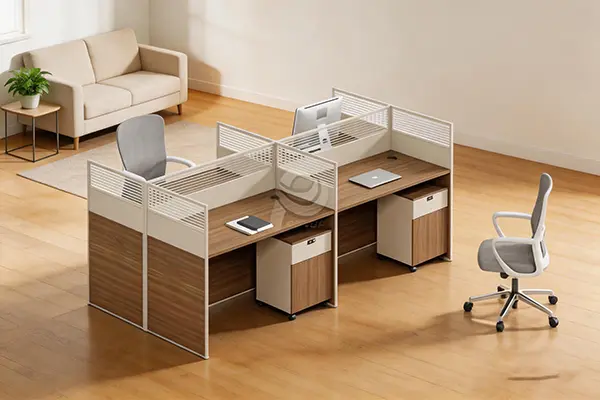
The work should decide what size desk to use, not a catalog setting. Width determines where to put the monitor and how much space there is for paperwork. Depth determines how far away you can see and where to put the keyboard. Each type of workstation (single, benching, clusters, L-shapes, and screened) trades privacy for density. As a whole, our Professional Employee Desk Unit measures 2460 x 1220 x 1100 mm, which is 97 x 48 x 43 inches. It has an off-white metal frame and a light wood-grain top. Teams that want a clear personal space in an open plan will like that footprint. Before you multiply it across a floor, look at the footprint and see how wide your aisles are.
Set Budget, Schedule, and Scope Early
Every later choice is based on price, time, and scope. Write down the desired quantity, the cost per workstation, the due date for delivery, and the name of the person who will be installing it. Choose whether you want a standard model, a modular system, or an OEM version that you can brand yourself. On the same sheet, write down the warranty terms and any paperwork that is needed, like drawings and material reports. When procurement managers give this information in the first conversation, they usually get faster and more accurate quotes because the supplier can match the right configuration without having to go through multiple rounds of clarification.
Judge Ergonomics, Materials, and Build Quality
Check Ergonomics and Accessibility
Comfort is a must, because ergonomics affects work output daily. ANSI/HFES 100 and ISO 9241-5 offer guidance on how to set up and sit at a workstation. These include desk height, legroom and where to position the monitor. ADA Standards 2010 requires work surfaces to be 28 to 34 inches above the floor for use by people with disabilities. This is important for public, school and government sites. See edge profiles, knee space and chair compatibility on a real sample. If you’re planning on sit-stand desks, check out the lift range, stability, noise level and anti-collision protection. Avoid wasting your money on fancy features that look good but do absolutely nothing for your posture.
Inspect Worktop, Screen, and Edge Materials
The ageing of a desk depends upon what it is constructed from. The top surface of our Professional Employee Desk Unit is made of Moon Tree board, 25 mm thick, GB E0 grade, no-odor, eco-friendly, with 2 mm PUR edge banding. PUR glue offers a tight edge seal that prevents water ingress and prevents the seams from lifting. The screens are constructed from 20 mm Moon Tree GB E0 board, 1.2 mm wall aluminium and 2.5 mm wall zinc alloy fittings. The aluminium is sandblasted on the outside and is anodized. Ask them all the same questions about metal wall thickness, board grade, edging method and board thickness.
Verify Testing and Compliance Documents
When ordering a lot paper proof is important. ANSI/BIFMA X5.1 X5.5 provides procedures for testing the strength and durability of desks and tables. Ask the suppliers what tests they conduct or can provide evidence of. BIFMA e3 talks about building furniture that lasts. All composite wood sold in the U.S. must meet the limits for formaldehyde set by EPA TSCA Title VI. Our list of products includes E0 grade boards and SGS CEC certification, PENGPA I says they meet E1 and E0 formaldehyde standards. For a U.S. project, obtain specific report numbers and test scopes so your QA team can verify they meet local requirements.
Plan Privacy, Storage, and Technology Support
Balance Privacy and Airflow with Screens
People who live in open plans need privacy without feeling suffocated. The Professional Employee Desk Unit has solid wood panels below and horizontal slats on top. The upper section with louvers keeps your eyes from getting distracted while letting air flow through the station. At seated level, the solid lower panel blocks your view. Off-white metal against light wood grain gives the design depth while keeping it simple. Screens with slats work well for teams that need to concentrate but still want to share a floor. Before you agree to a layout, make sure that the screen height and panel style meet your privacy needs.
Use Mobile Pedestals for Flexible Storage
Storage changes the amount of legroom, the ease of cleaning, and the layout options. There is a two-tone mobile pedestal cabinet with three drawers at each station. The pedestal can be rolled out of the way when facility teams need to rearrange a floor, and employees can keep files and personal items close at hand. Mobile pedestals make it easy to switch out drawers during team moves, while fixed built-in drawers don't. Putting cabinets in one place saves desk space but makes you walk around more. Check the pedestal's size against the desk's knee space and count how many drawers each person needs. Also, decide if you need locks.
Coordinate Cable Management and Power
Phones, laptops, docks, and monitors all need power, so make sure that furniture has plugs early on. Look over the grommets, cable trays, under-desk channels, and power modules, and then use the building plan to match them to the floor boxes and wall outlets. The standard listing for this desk doesn't list any cable accessories, so I ask buyers to send me a picture of how they have their power and data set up. Then, our engineering team can look at the options by customizing them and making 2D and 3D drawings. You can ask any supplier to show you how to route cables on a drawing, not just in a brochure. Putting in power is still governed by local electrical codes.
Compare Options and Avoid Costly Mistakes
Compare Commercial and Basic Desks on Total Cost
But the unit price is not the whole story. Commercial grade desks may seem more expensive initially, but they can save you money in the long run by minimising replacements, repairs, and downtime. When you add up the purchase price, freight, installation labour, spare parts and warranty handling, you have the full picture of what it all costs. Fixed layouts are best for stable teams. Modular systems are best for growing businesses and flexible schedules. A cheap desk that needs to be replaced too soon can cost more than a stronger one over the course of the project. To be fair, get each supplier to give you the same cost lines.
Avoid Common Planning Errors
Planning flaws, not bad product design, are the cause of most furniture problems. Some people only look at price, and then they find that their Professional Employee Desk Unit has weak or loose frames or edges. Some don't measure and then find that a desk is in the way of an outlet or an exit. Some people agree to mass production without testing a sample first. Check one unit's size, finish, drawer movement, technology fit, and how long it takes to put together. Make sure that all floors have the same desk families, finishes, and parts so that repairs are easy. Also, make sure the supplier can make the same finish again, since orders for more are often placed months after the first delivery.
Plan Stock, Lead Time, and Installation
Timelines make projects fail. This Professional Employee Desk Unit is in stock at our warehouse in Foshan, China. This helps buyers who are on a tight schedule or who are placing pilot orders. Please check the current amounts before making plans based on them. For larger orders, our process starts with analyzing the needs, then moves on to design development, sample approval, mass production, quality control, and delivery around the world. Structures that are knocked down and protective packaging make them easier to ship and put together on-site. Make sure you get a written schedule with dates for approval of samples, shipping, and installation. Also, let them know early on your US delivery address and receiving hours.
Evaluate the Supplier and Make the Final Decision
Build a Supplier Checklist
It doesn't matter how good the desk is if the supplier can't deliver it on time every time. These are the first three places I check:.
-
Manufacturing control. Ask whether the supplier has its own factory, how many lines it runs and how it controls the materials, production and pre-shipment quality. PENGPA I run a modern factory in Shunde, Foshan, with production lines brought in from Italy and Germany and a quality monitoring system.
-
Customisation and engineering: 2D/3D drawings, prototype help, technical validation. PENGPA. I tailor size, structure, material, finish, colour, branding and functional configuration. Designers and contractors can assess feasibility before mass production begins.
-
Project management and support: Identify a named contact to monitor production and delivery. PENGPA Each project has a dedicated project manager, I can guide you through installation, warranty support, spare parts and fast after sales service.
You can tell if a supplier can keep to your schedule and keep the quality of the bulk close to the approved sample by these checks.
Match Desk Types to Use Cases
Each office needs a different mix. Floors in open-plan and headquarters should have the same finishes and aisles should be clear. In call centres there is a need for small stations where people can be alone and parts can be replaced quickly. Executive and reception areas require high-quality surfaces, visitor-facing designs and hidden wiring. Flexible floor plans are a must for coworking and hybrid spaces. Cleaning access and compliance documents should be included in the list of people who buy from the government, schools and hospitals. A mobile pedestal and a screened desk are great in open plan offices and shared work spaces. However, for executive offices, you’ll need larger custom pieces.
Score Options with a Weighted Decision Matrix
The weighted matrix keeps the decision goal. List factors such as size, comfort, durability, space, cable management, safety, legality, customisation, delivery, warranty and total cost. Arrange the weights based on the significance of the projects. A call centre might put the most importance on small size and durability, whereas an executive office might put more importance on finish and storage. Separates things into two piles: must-haves and nice-to-haves. Then weed out anything that does not satisfy a must-have. Run a pilot installation to see how long it takes to assemble, how stable it is, how the drawers are used and what employees think before full rollout.
Conclusion
Choosing a Professional Employee Desk Unit should be a project decision based on facts. At the beginning of the process, there is a site review and role list. Then we have ANSI / HFES 100 , ISO 9241-5 and ADA Standards for dimensions , ergonomics and accessibility . Test and compliance documents verify quality, while board thickness, edge banding, and metal wall thickness reveal how a desk will wear over time. For everyday use, privacy screens, mobile storage and cable planning are characteristic. Total cost, stock, lead time, and installation scope all shape budgets and schedules. Supplier checks and a weighted matrix can be used to make these points a clear choice for business office projects.
FAQ
What size is the PENGPAI Professional Employee Desk Unit?
Sizes given are 2460 x 1220 x 1100 mm, which are about 97 x 48 x 43 inches. It has a light wood-grain top, off-white metal walls with slatted tops and solid bottoms, and a two-tone mobile pedestal with three drawers.
Which materials and certificates apply?
Moon Tree GB E0 board that is 25 mm thick and has 2 mm PUR edge banding is used for the countertop. 20 mm GB E0 board, 1.2 mm wall aluminum, and 2.5 mm wall zinc alloy fittings are used to make the screens. The listing has a 5-year shelf life and is certified by SGS CEC.
Is the product in stock, and can you customize it?
Things are in stock at our warehouse in Foshan, China. Our engineering team can change the size, materials, finishes, colors, and branding of projects. Before mass production, they provide 2D and 3D drawings and samples.
Request a Professional Employee Desk Unit Quote from PENGPAI
Are you ready to choose a Professional Employee Desk Unit for your next project in the office? PENGPAI is a company in Foshan that makes Professional Employee Desk Units. We have stock in our Foshan warehouse, can provide 2D and 3D drawings, confirm samples, and assign a project manager to each order. Send your layout, finish, and quantity needs to kiki@pengpaifurniture.com, and we'll make you an itemized quote. For more information, go to pengpai-furniture.com.
References
1. ANSI/BIFMA X5.5 Desk/Table Products – Tests, BIFMA, 2014
2. 2010 ADA Standards for Accessible Design, U.S. Department of Justice, 2010
3. ANSI/HFES 100 Human Factors Engineering of Computer Workstations, Human Factors and Ergonomics Society, 2007
4. ISO 9241-5 Ergonomic Requirements for Office Work with Visual Display Terminals – Workstation Layout and Postural Requirements, International Organization for Standardization, 1998
5. BIFMA e3 Furniture Sustainability Standard, BIFMA, 2019
6. Formaldehyde Emission Standards for Composite Wood Products (TSCA Title VI), U.S. Environmental Protection Agency, 2016
Online Message