
Nov 11, 2026
How to Choose a Sleek Collaborative Conference Centerpiece for Modern Meeting Rooms
To choose a Sleek Collaborative Conference Centerpiece for a modern meeting room, start with how the room works. Measure the table, count the seats, and list the power and cable needs. Next, pick durable materials, a low profile, and proportions that leave every person enough working space. Then compare standard and custom options, request samples and drawings, and check the supplier's production and delivery record. I recommend scoring each option against the same specifications. This method keeps the decision objective and lowers risk, whether you outfit one boardroom or a multi-site rollout.
Define Your Meeting Room's Functional and Design Requirements
Identify Who Uses the Room and How
Every day, what does this room do? That's the first thing I always inquire. Project teams need to be able to quickly get to a clean surface and power for stand-ups. A clean, branded look and a good finish are more important in an executive room that is used for talks with clients. Write down the average number of people in the group, how long the meeting lasts, and what tools people bring. In places like schools, hospitals, and government buildings, where safety and durability are often the most important things, it's extra thick. People won't buy the wrong design for rooms that are used in very different ways if there is a short written description of each type of room.
Plan for Hybrid Meeting Technology
The way rooms are used has changed because of meetings with mixed groups. There is a movement toward flexible work plans where people can do their jobs from anywhere. Harvard Business Review has written about this. A lot of companies now use video calls all the time. That's why cameras, microphones, and screens are on the list before anyone chooses furniture. It's helpful to keep track of where everything is and where the wires connect. Then, make sure that the meeting table's centerpiece doesn't block a screen or camera view. Power and USB ports are set up in the middle of the table so that people can charge their laptops without having to run cords across the table. Check the places where the cables go early on because it's hard to change them once they're in place.
Check Table Shape, Clearance, and Project Priorities
When selecting a Sleek Collaborative Conference Centerpiece, start by evaluating the table shape, seating capacity, and available clearance between the table edges and surrounding walls. There should be enough room for people to move comfortably behind seated chairs and access the conference area without obstruction. Accessibility is also an important consideration for projects in the US. The 2010 ADA Standards for Accessible Design specify requirements for accessible work surfaces and clear floor spaces, so procurement teams should consult the applicable standards and confirm the project's specific requirements with their design professionals. A typical 750 mm-high conference table is approximately 29.5 inches tall, but this measurement alone does not establish ADA compliance. Beyond dimensions and accessibility, buyers should evaluate how well a Sleek Collaborative Conference Centerpiece meets the project's practical requirements. Important purchasing considerations include manufacturing lead time, material durability, product documentation, protective packaging, and the supplier's ability to provide consistent replacement or repeat orders in the future. By reviewing these factors early, procurement teams can select a Sleek Collaborative Conference Centerpiece that supports comfortable collaboration, fits the room layout, and meets the long-term needs of the organization.
Establish the Core Selection Criteria for a Sleek Collaborative Conference Centerpiece
Judge Function Before Decoration
A good focus is meant to solve a problem that people have every day. Check to see if it makes it easier to charge, store, manage cables, or work with others without making it too crowded. One answer to the question "Where do I plug in?" that comes up at every meeting is a pedestal with a power outlet and USB ports. Having items around takes up room and needs to be cleaned. First, write down the three most important things the room needs to do. Then, get rid of the rest. The price stays low, and the table is simple to read. Use soft colors and clean lines instead of extra parts if you want to look classy.
Check Materials and Durability
The things that are used in business places need to be able to be hit, scratched, stained, and cleaned many times. What kind of steel is in the frame? Look at how thick the board is and how the edges are finished. A lot of buyers don't understand how important edge banding is until they see how dust and water get into open sides. Find out what kinds of tests are used. That's why X5.5 covers ANSI/BIFMA tests for desk and table goods. This gives buyers a way to compare sellers. What kind of air is inside is also important. As per TSCA Title VI of the EPA, formaldehyde composite wood sold in the US can only emit so much. Make sure you get all the paperwork you need for your project.
Verify Safety, Accessibility, and Serviceability
It keeps people safe in busy rooms with rounded edges, stable legs, and a safe way to mount it. To check if the table is stable, put your hand on the top and lean on the corners. Check to see if the joints can move. Sightlines can also change how comfortable you are. Like, a tall centerpiece can make it hard to see people and make it take longer to talk. The wires can be reached without taking the table apart if there are parts that can be serviced, like a junction box cover that can be taken off. Make sure you have finished examples, installation directions, and test papers before you sign off on something. It's much cheaper to make changes before delivery than to wait until after delivery to take a look at a sample.
Choose the Right Size, Proportion, and Solution Type
Measure for Proportion and Personal Space
When it's the right size, a table looks good and works well. Measure the table's length, width, and height, and then draw lines for the seats, screens, and microphones. Everyone needs a spot to put their drink, laptop, and notes. For a small table, a low-profile unit that is small works best. For a long table, a plan that is flexible or has more than one section might work better. More than that, and it gets in the way of writing. Less than that, and it looks like it doesn't belong on the table. Make sure that the modules can be moved, linked, or changed without leaving gaps or making it hard to set up if you want to change how the room is set up later.
Compare Minimalist, Decorative, Fixed, and Portable Options
A Sleek Collaborative Conference Centerpiece with a minimalist design provides ample room for meetings, presentations, and shared work without making the space feel crowded. Decorative elements can make a conference room feel more welcoming or reinforce a company's brand identity, but they may require additional cleaning and maintenance. Fixed conference table systems help keep cables organized and integrated features in place, while movable configurations are more suitable for rooms that frequently change their layouts. Standard models of a Sleek Collaborative Conference Centerpiece generally offer shorter lead times and more predictable pricing. By comparison, custom designs for unusual room dimensions, branded finishes, or OEM programs provide greater flexibility but usually require additional time for design development and sample approval. Before choosing a model, procurement teams should consider assembly time, lifetime costs, maintenance requirements, minimum order quantities, and the ability to adapt to future workspace changes. For most corporate meeting rooms, a consistent, low-profile design with integrated power access offers a practical balance of appearance and everyday functionality. A well-designed Sleek Collaborative Conference Centerpiece can therefore help businesses maintain a clean, organized, and efficient meeting environment while supporting changing collaboration needs.
Match the Centerpiece to Your Project Type
Different people need different things. For business offices, simple designs that can be used in many rooms work well. Hotel and business areas like styles that stay the same from room to room. It's very important for public and healthcare buildings to last and be clean. They need to check the extra parts, the papers, the packaging, and the amount of stock they have. Branding, prototypes, quality checks, drawings, and materials should all be chosen by OEM buyers at the start. For interior designers and contractors, the best suppliers are those who give technical drawings and can make changes to the layout quickly. You can avoid delays and extra work in the future by making sure the product fits the way people buy it.
Evaluate the Supplier and Use a Practical Decision Method
Look Beyond Photos and Unit Prices
It doesn't matter how cheap something is if the mass production doesn't match the sample that was okay. Find out about the company's tech team, quality control steps, history of exporting, and ability to handle your traffic. Ask for examples of the finish, information about the materials, measurements, and directions on how to put it together. Make it clear what the quote includes, like freight, samples, tools, shipping, warranty, spare parts, and other costs. The wait times for samples, production, and shipping should be broken down. Also, check that the boxes are the right size, have the right labels, and are stacked correctly. When you order a lot of things, knock-down buildings save room and make it easy to put them together. As long as a seller answers technical questions fully and quickly, they usually run projects the same way.
Build a Weighted Scorecard
What people say is given a numerical value in a weighted evaluation. Design fit, size, function, material longevity, upkeep, modification, source capacity, shipping, total cost, and help after the sale are all things that should be included. Based on the project, give each group a certain amount of weight. For executive interiors, how things look might be very important, but for rollouts to multiple sites, durability and ease of use might be more important. Give at least two or three products the same score and look over samples or finish boards before giving the final OK. Come in person to look at the installation, cleaning, and cable access. Give the finance and facility teams the scorecard that is fully filled out so that everyone can see why the option that was chosen was the best one.
Avoid Common Selection Mistakes
People get into a lot of trouble when they buy something based on how it looks instead of seeing how well it works. When the units are too big or too small, it's hard to see what's on the table. It takes up space and costs money to add more lights, storage, or charging ports that don't help users. When teams place an order, they forget to check where the wires go in and out, how to place the item, how to clean it, and the terms of the guarantee. Some people also think that a finished sample shows that the whole thing is good, which is not true. Ask the seller how they make sure that the mass production matches the accepted sample, and find out more about the inspection that happens before the goods are sent out. The project stays on track with these quick checks.
Recommended Specifications for a Professional Modern Meeting Room
Product Structure and Design
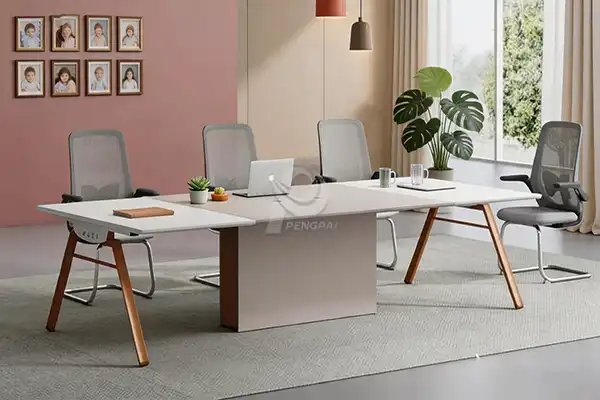
The Sleek Collaborative Conference Centerpiece is the modern conference table we have for sale. The top is smooth and white, and the legs are angled and made of light wood. The two splayed legs on either side give it structure and a clean look. The middle base is shaped like a square box. The desk can be taken apart, which means the table can be used in different-sized rooms. For charging, it comes with a cover for the power socket and a USB junction box. On the item page, the color is called Morandi Orange, and the description talks about legs that are a warm wood tone and a white matte top. When you ask for examples, please talk to our team about the right way to finish them.
Materials and Construction
The side legs of the panel are made of 25 mm of Moon Tree E0 environmentally friendly board with 2 mm of PUR edge banding. All the panels have bands around their edges that keep dust out and make the whole thing look nice. Along with frame legs made of 1.2 mm steel that are one of a kind, the side legs are made of 40*20 U-shaped 1.5 mm steel bars. This is important because the steel holds up the weight and the board doesn't wear out quickly. We can talk about the forms your project needs because the US market has its own rules about formaldehyde. At our plant, we also check the materials, keep an eye on production, and make sure everything is okay before sending.
Sizes, Stock, and Certification
There are five millimeter sizes: 2400x1200x750, 2800x1200x750, 3200x1200x750, 3600x1380x750, and 4200x1380x750. These range from little boardrooms to big meeting rooms. Stock is kept in our Foshan, China, building, which helps with quick turnaround. The item is approved by SGS CEC and can be kept for 5 years. It is possible to change the shape, size, material, finish, color, logos, and function. 2D and 3D models and prototypes can help with this. There is a clear process for each project that includes figuring out what is needed, making a design, making sure the model works, mass production, quality control, and shipping all over the world. A dedicated project manager is in charge of the whole thing.
Conclusion
When choosing a Sleek Collaborative Conference Centerpiece, you should think about who will be using the room, the types of technology that will be used, the shape of the tables, and the space between the furniture. For long-term use, it's more important that the materials are strong and the edges are smooth than how they look. You can also tell if the decoration helps or clogs up the table by its size. You won't have to buy the wrong things if you match the type of project with the minimalist, decorative, fixed, movable, standard, and custom options. If the seller checks the plans, samples, wait times, and packaging details, there is less risk of delivery going wrong. With a weighted scorecard, the final choice stays objective. It's fair to compare goods if they have measurements for things like board width, steel scale, and names of sizes. It's important to remember that before giving your approval, you should look at how things work and fit together, not just how they look.
FAQ
What size should a conference table centerpiece be?
It should fit the table and the way people are sitting. Make sure everyone has a place to put their laptop, notes, and drink, and that everyone can see the screens and cameras. There are two types of tables: shorter ones work best for small, low-profile units and longer ones work best for modular layouts.
What does the PENGPAI centerpiece include?
It has an angled light wood base, a square platform in the middle, a white modular tabletop, and a cover for the USB/power outlet box. The panels are made of 25 mm E0 boards with PUR edge bands. The frame is made of 1.5 mm steel beams and 1.2 mm steel legs.
Can the design be customized and shipped from stock?
And yes, we do have stock in our warehouse in Foshan. We can change the size, materials, finishes, color, marking, and how they work. Our team makes 2D and 3D drawings and prototypes for project orders.
Request a Sleek Collaborative Conference Centerpiece Quote from PENGPAI
Are you planning to roll out in a boardroom, a hotel business center, or more than one place? In Foshan, I keep Sleek Collaborative Conference Centerpieces that I make at PENGPAI in stock. You can make projects fit your needs with the help of 2D and 3D models. They come in five sizes. Our project team will get back to you with a clear quote after you send kiki@pengpaifurniture.com the size, quantity, and delivery address of your table. Go to pengpai-furniture.com to learn more.
References
1. BIFMA International, ANSI/BIFMA X5.5 Desk/Table Products – Tests, 2014.
2. U.S. Environmental Protection Agency, Formaldehyde Emission Standards for Composite Wood Products (TSCA Title VI), 2016.
3. U.S. Department of Justice, 2010 ADA Standards for Accessible Design, 2010.
4. Harvard Business Review, "Our Work-from-Anywhere Future," 2020.
5. Gensler Research Institute, U.S. Workplace Survey, 2023.
6. International WELL Building Institute, WELL Building Standard v2, 2020.
Online Message