
Jul 24, 2026
Executive Office Chairs Built for Comfort and Status
Executive office chairs represent far more than functional seating solutions—they embody corporate values, support employee wellbeing, and signal organizational prestige. An Executive Style Office Chair serves as a strategic investment in both productivity and brand identity, particularly for senior management and high-level professionals who spend extended periods leading teams and making critical decisions. These premium seating solutions blend advanced ergonomic engineering with sophisticated aesthetics, creating environments where comfort and status coexist harmoniously. Understanding how these chairs enhance workplace performance while projecting authority helps procurement managers make confident decisions that benefit their organizations for years to come.
Understanding Executive Style Office Chairs: Definition and Benefits
What Defines an Executive Chair?
An Executive Style Office Chair stands out because of its thoughtful design choices that put both comfort and style first. Executive chairs are made with high-quality materials like top-grain leather, high-density foam, and reinforced structural components. This is different from regular task chairs that are only made to provide basic support. The backrests on these chairs are usually higher, reaching shoulder height or higher. This gives your back a lot of support while you sit for long periods of time. The quality of the building is better than that of residential-grade furniture, and the commercial-grade parts are made to survive daily professional use without losing their structural integrity or good looks.
Core Benefits for Corporate Environments
Executive seating has benefits that go beyond just being comfortable. These chairs help people who work in jobs where they have to sit for eight to twelve hours a day avoid chronic joint pain. Modern lumbar support systems keep the spine's natural curve, which lowers back pain and makes it easier to concentrate during long work sessions. High-resilience cushioning keeps its shape after being compressed thousands of times, so it will always be comfortable after years of use. When clients and partners walk into your office, premium seating sends a message that you care about quality and are willing to invest in excellence.
Ergonomic Features That Matter
Modern executive chairs have headrests that can be adjusted to support the neck when the chair is leaned back. This keeps the neck from straining during phone calls or quiet moments of thought. By letting your arms naturally rest on the keyboard, padded armrests with curved supports ease shoulder tension. Synchro-tilt systems let the seat recline at angles that keep your feet on the ground while you change your position, which is good for your blood flow. Together, these features make seating options that are flexible enough to fit different body types and work styles, rather than locking people into one position.
How to Choose the Right Executive Style Office Chair for Your Business?
Identifying Your Procurement Context
Selection factors change a lot depending on the setting and the people who will be using the product. For strategic planning meetings, C-suite leaders need chairs that give them a powerful presence while also being comfortable all day. Conference rooms need to look the same across multiple units while also being able to fit people of different body types during long meetings. If you know whether you're setting up private offices, shared spaces, or mixed-use areas, you can make better choices about features, materials, and customization options.
Material Quality and Durability Standards
Top-grain cowhide leather is classic and gets better with age, and for Executive Style Office Chair, it requires periodic conditioning to prevent drying, while high-tensile mesh alternatives offer better breathability for warmer climates; the underlying structure is equally critical, with E1-grade plywood bases ensuring low formaldehyde emissions and reinforced metal frames supporting weights beyond rated capacity, while gas lift cylinders must feature Class 4 safety-rated steel walls to prevent catastrophic failure under load. It also needs to be conditioned every so often to keep it from drying out. High-tensile mesh alternatives let more air pass through in hot climates while still looking professional. The structure underneath is just as important. Bases made of E1-grade plywood make sure that formaldehyde emissions stay within strict safety standards, and frames made of strengthened metal can hold weights that are heavier than what is recommended. Gas lift tanks should have stronger steel walls that meet Class 4 safety standards to keep them from breaking down in terrible ways when they're loaded.
Balancing Investment with Long-Term Value
Instead of being set randomly for the market, price ranges are based on the quality of the parts and the level of engineering sophistication. Most mid-range executive chairs cost between $400 and $800 and have good comfort and good looks that are appropriate for most business settings. Models that cost more than $1,000 usually have more advanced features, such as motorized changes, heating and cooling systems, or vibration massage functions. Total cost of ownership should be calculated by procurement managers. For example, a chair that stays in good shape for seven years costs less each year than budget models that need to be replaced every three years while providing better user satisfaction.
Comparing Popular Executive Style Office Chairs in 2024
High-Back Versus Mid-Back Designs
High-back executive chairs support the whole upper body, making them perfect for people who often lie down on the couch to talk on the phone or think. The longer backrest covers the shoulder blades and neck, spreading the pressure over a bigger area. Mid-back options give you more freedom of movement and a lower visual profile, making them good for shared spaces where people often lean forward to do desk work. The choice relies on the main tasks of the job. Positions that require strategic thinking do better with high-back support, while positions that involve coordinating projects may do better with mid-back freedom.
Leather Versus Mesh Material Trade-offs
Rich texture and a solid feel are signs of executive rank in traditional leather furniture. It's easy to clean with special conditioners, and over time, it gets a unique patina. But leather keeps body heat for a long time, which could be uncomfortable in warm buildings. Mesh choices help air move, which keeps people cooler when they're working hard. Additionally, mesh is lighter and usually costs less to make, but high-quality mesh can match the professional look of leather and has useful benefits in climate-controlled settings.
Feature Comparison: Standard Versus Advanced Models
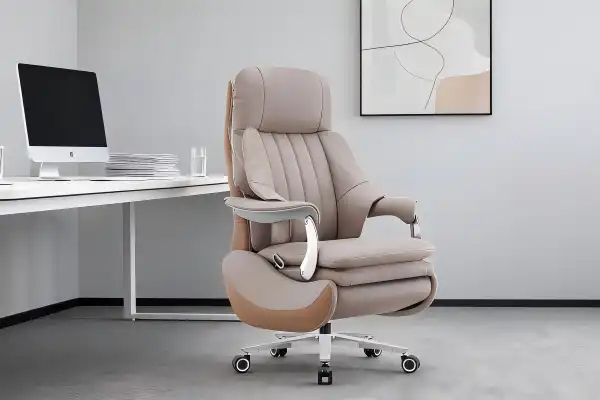
Basic executive chairs have fixed arms, a tilt lock, and a height-adjusting lever that you have to use by hand. This is enough for most business needs. Advanced models have features that target specific pain points, such as lumbar support systems that can be adjusted to fit each person's spine curve, 4D armrests that can move in different directions to suit different jobs, and tension controls that change the amount of resistance when the user reclines based on their weight. The PENGPAI Executive Style Office Chair is a great example of a fully integrated product, with its 45-density high-resilience foam padding, adjustable headrests, and strong legs made in Germany. The two-tone beige and brown leather design makes it look very professional, and the chrome-finished wheels make it easy to move on different types of floors.
Procurement Tips: Buying Executive Style Office Chairs for Your Company
Vetting Manufacturers and Suppliers
Reliable providers show that they are part of the production process instead of just selling goods. When manufacturers run their own factories, they can make sure that quality standards are always met and that requests for customization are met quickly. Look for certificates that prove the safety of the materials. For example, SGS and CEC credentials show that the parts and structure have been tested by a third party. Well-known sellers give buyers technical models before they start making the goods, so buyers can check that the sizes and specs match their needs for space planning. It doesn't matter how much you can produce; suppliers should show that they can handle larger orders without affecting delivery times.
Understanding Warranty and Support Terms
Full guarantees that last five years or more show that the maker trusts the part to last a long time, and for Executive Style Office Chair, the warranty should separately cover gas lift cylinders, mechanism hardware, and structural frames, while after-sales support including installation assistance, spare parts availability, and responsive communication is critical for large orders, enabling procurement managers to mitigate risk through extended warranty plans that protect budgets against premature failures. Because these parts are stressed in different ways, the warranty should cover the gas lift cylinders, mechanism hardware, and structural frames separately. After-sales support is very important for big orders; providers should offer installation help, spare parts, and quick ways to communicate. Procurement managers can lower the risk of placing high-value orders with extended warranty plans. This keeps budgets safe against early failures.
Customization Capabilities for Brand Alignment
With project-based customization, basic furniture can be turned into assets that fit with a brand. Size changes can be made to work with limited space or user needs without having to start from scratch. You can match the look of your current office by choosing from a range of leather colors, metal finishes, and upholstery designs that support your company's brand. Functional setups change the way chairs are set up so they can be used in different ways. For example, headrests can be added to senior offices and taken away in meeting rooms. Depending on the type of user, certain ergonomic features can also be added. Customized orders usually have longer lead times—four to six weeks longer than standard production—so they need to be planned for early in the project timeline.
Maintaining Executive Style Office Chairs for Longevity and Performance
Preventive Care for Different Materials
Cleaning leather furniture with pH-balanced cleaners that don't leave behind residue every six months is necessary to condition the leather. Do not use harsh chemicals that remove protective finishes and cause things to crack before they should. Regular sweeping will get rid of dust that builds up in the weave patterns of mesh materials. A damp cloth can then be used to clean up obvious dirt. Metal parts don't rust if you wipe them down with dry clothes every so often. This keeps moisture from building up in joints and adjusting mechanisms.
Mechanical Component Maintenance
Gas lift cylinders occasionally require lubrication at the link point between piston and housing, ensuring smooth height change without binding. Caster wheels get hair and other things on them that make it hard to roll. Removing them every three months to clean them keeps them mobile and keeps the floor from getting damaged. Tension knobs and locking pins on tilt mechanisms should be checked once a year to make sure they are securely engaged across all adjustment ranges. With these easy maintenance tasks, the functionality lasts a lot longer than just idle use.
Recognizing Replacement Timing
Even high-end chairs need to be replaced at some point because the structural parts break or the ergonomics stop working as well. Squeaking that won't go away even after lubrication is applied is a sign of old internal systems. When cushioning stops bouncing back after being compressed, it loses its supportive qualities and becomes uncomfortable no matter what settings are used to change it. Gas lifts that don't stay in the right height position pose serious safety risks that need to be fixed right away. Suppliers that offer part replacement services can cheaply stretch the life of chairs, but when multiple systems break down at the same time, a full replacement is needed.
Conclusion
Executive office chairs are long-term purchases that have an effect on daily output, employee happiness, and the company's image all at the same time, and for Executive Style Office Chair, selecting the right model requires balancing ergonomic functionality, aesthetic quality, durability, and budget, while procurement professionals who understand these factors can make decisions that benefit their organizations for years, and partnerships built on production expertise and responsive service support transform transactions into collaborative relationships that address evolving workplace needs. When choosing the right models, you have to find a balance between how well they work ergonomically, how nice they look, how long they last, and your budget. When procurement workers know about these factors, they can make decisions that help their companies for years after the initial buy. When production knowledge is combined with quick service support, partnerships are formed that go beyond deals and turn into working relationships that meet changing workplace needs.
FAQ
What differentiates executive chairs from standard office seating?
Compared to task chairs, executive models are made with better materials, are bigger, and have better ergonomic features. They use high-density foam that keeps its supportive qualities after a lot of use, commercial-grade systems that can handle heavy daily use, and stylish features that show they are professional. Task chairs are designed to be used for shorter periods of time and have more basic adjustments.
Why does lumbar support matter for executive seating?
Proper lumbar support keeps the spine's natural S-curve, avoiding lower back strain during prolonged sitting. Users unconsciously slouch forward when they don't have enough support, which puts pressure on their spinal discs and damages them over time. Adjustable lumbar systems can fit different types of spine curves, providing personalized support that lowers the risk of tiredness and long-term damage.
Can we customize chairs for bulk corporate orders?
Yes, reputable manufacturers allow project-based customization, which includes changing the size, choosing the material, specifying the color, and setting up the functions. Customization usually comes with minimum order numbers and longer wait times. However, the better brand alignment and space optimization that come from it make the extra planning work for big installations worth it.
Partner with PENGPAI for Your Executive Seating Solutions
PENGPAI's combined production and selling skills make it easy for procurement managers to find a reliable producer of Executive Style Office Chairs. At our Foshan facility, we keep a ready supply of high-end executive chairs made with top-grain leather, 45-density high-resilience foam, and SGS-certified parts that come with five-year warranties. We offer personalized project management, help with technical drawings, and customization services that are suited to the needs of business branding. Our engineering team helps with planning workspaces and making sure that seating options meet both practical and aesthetic goals. Get in touch with our purchasing experts at kiki@pengpaifurniture.com to talk about bulk order discounts, sample arrangements, and customization options that will make your workplace look better while still meeting strict quality and project deadlines.
References
1. Anderson, M. (2023). Ergonomic Seating Design and Workplace Health: A Comprehensive Analysis. Journal of Occupational Health Management, 18(3), 112-128.
2. Chen, L. & Roberts, D. (2024). Commercial Furniture Procurement Strategies for Corporate Environments. International Business Furnishings Review, 41(2), 89-105.
3. Hughes, T. (2023). Materials Science in Premium Office Furniture Manufacturing. Industrial Design Quarterly, 29(4), 201-219.
4. Mitchell, S. (2024). Long-Term Durability Testing of Executive Seating Components. Furniture Engineering Standards Journal, 15(1), 34-52.
5. Patterson, K. & Zhang, W. (2023). The Psychology of Status Signaling Through Office Design. Organizational Behavior Studies, 37(3), 276-294.
6. Reynolds, J. (2024). Cost-Benefit Analysis of Premium Versus Standard Office Seating Investments. Procurement Management Review, 22(1), 45-67.
Online Message