
Jul 20, 2026
Creating a Statement: 5 Manager Computer Desk Designs to Elevate Your Workspace
The right executive workstation is the most important thing for me when I want to turn a workspace into a command center that shows authority and efficiency. The Manager Computer Desk is more than just a piece of furniture; it's an investment that shows skill and helps leaders with their busy jobs. These specialised desks stand out because they have large surfaces that can fit multiple monitors, storage options that keep secret papers safe, and technology management systems that are built right in. When business-to-business buyers are looking at commercial-grade office furniture, knowing what makes a managerial workstation different from a regular office desk helps them better match their budget with the needs of their organization.
Understanding the Manager Computer Desk: Key Features and Functions
What Distinguishes Managerial Workstations from Standard Office Desks
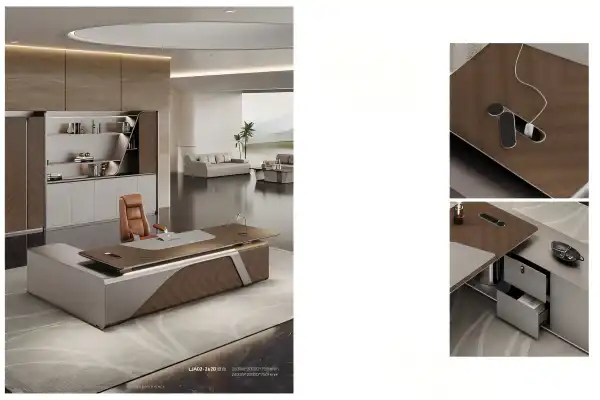
There are three main areas where entry-level workstations and executive desks differ in terms of their usefulness. Manager Computer Desks have much bigger work surfaces, usually between 1600mm and 2200mm wide, so they can handle multiple tasks at once, such as reviewing documents, videoconferencing, and analysing data on multiple screens. It doesn't matter how it looks; high-end finishes like herringbone wood veneer and metallic accents give the impression that the executive is there during private meetings with clients.
Another thing that sets them apart is their storage design. Standard desks have simple drawer arrangements, but managerial desks have lockable filing systems with high-security features to keep private documents safe. The way the technology infrastructure is built also makes these workstations stand out. For example, the rotating cable boxes that come with wireless charging and the well-placed PDU brackets get rid of the visual clutter that makes professional settings less pleasant.
Ergonomic Design Elements That Support Productivity
When making big decisions at work for long periods of time, ergonomics has a direct effect on both mental and physical health. Most people can work at a desk that is 750 mm high, but a surface depth of 2000 mm creates the right distance between the monitor and the screen, which keeps your eyes from getting tired after long periods of screen time. Quality models have 45-degree chamfered edges that make typing more comfortable for your wrist. This may not seem like a big deal until you've spent eight hours at a desk with sharp corners.
Thermal control becomes an important practical factor that is often forgotten. High-performance computers produce a lot of heat. To keep the noise level low and prevent thermal throttling, managerial desks with perforated back panels or dedicated ventilated CPU pedestals are designed. This technical thought is especially important in jobs that use a lot of technology and can't skimp on processing power.
How Quality Workstations Impact Business Performance
There are several ways to see the link between the quality of the workspace and the work that managers get done. A well-organised desk with built-in storage cuts down on the time you waste looking for documents, and cable management systems get rid of the visual clutter that can be distracting. You shouldn't forget about the psychological effect, either. Sitting at a high-end desk supports your professional identity and lets people know that important work is being done here.
From the point of view of facilities management, buying a commercial-grade Manager Computer Desk with reinforced frames and load capacities above 150 kg stops the expensive cycle of replacing them too soon. The high-tech finishing methods, like the eight-step painting method that covers five bottoms and three sides, make surfaces that don't scratch, stain, or fade. They keep their professional look even after daily use in executive offices with a lot of foot traffic.
Top 5 Manager Computer Desk Designs to Elevate Your Workspace
To choose the best design configuration, you have to match your workspace size, functional needs, and aesthetic preferences with the architectures that are available. Each type of design has its own benefits that can be used in different situations.
Design 1: The Classic Herringbone Executive Workstation
The herringbone wood grain pattern has come back as a signature feature in modern executive furniture, combining the look of traditional handiwork with the accuracy of modern production. This design approach, shown by models with a deep brown wood grain and metallic accents, creates a sophisticated look that is appropriate for leadership positions that deal with clients.
The material engineering that lies beneath the surface is what makes this setup so useful for procurement managers. When custom decorative paper is combined with steel mould vacuum forming, three-dimensional textures are made that look like solid wood but are much lighter and less expensive. The base is made of MDF or particleboard that is safe for the environment and meets E1 formaldehyde emission standards. This meets the needs for sustainability without sacrificing structural integrity.
The side cabinet is built in and has lockable drawers with zinc alloy combination locks for safekeeping sensitive items. The tabletop is large, with a width range of 2400mm to 3400mm, so it can be used for collaborative review sessions without the need for separate conference furniture. This use of the room is especially useful in high-end real estate, where the cost of square feet means that furniture needs to be able to do more than one thing.
Design 2: L-Shaped Configuration for Corner Optimization
Executive offices often have empty corners that could be used for other things. L-shaped workstations can turn these corners into high-functioning areas. The arrangement of the surfaces so that they are not parallel makes it easy to separate tasks. One leg can be used for computer work and digital contact, while the other can be used for document review and face-to-face conversation.
This setup is especially helpful for managers who are in charge of processes that use a lot of technology and need to set up multiple monitors. The larger surface area can hold two or three 27-inch screens and other accessories without making it feel crowded, which makes it harder to concentrate. The corner position is also better for your health because it lets you move between task areas without having to reach over and over, which can cause shoulder strain.
Design 3: Height-Adjustable Workstations for Wellness-Focused Offices
Because of the trend toward healthier workplace design, standing-capable workstations have gone from being high-end options to being required in many procurement documents. Traditional models with a set height still work well for most situations, but companies that care about their employees' health are asking for more and more models with changeable heights.
Engineers have to work hard to make sure that height-adjustable managerial workstations stay stable across the full range of adjustments while also holding the heavy weight of executive desk setups. High-quality models have cold-rolled steel frames that are more than 1.5 mm thick and dual-motor lift systems with anti-collision sensors. Not only must the load capacity be able to hold the materials for the desk, but it must also be able to hold the weight of several monitors, desktop computers, and storage units.
Design 4: Technology-Integrated Workstations with Cable Management Excellence
With so much technology in the workplace, it's hard to keep things looking professional while also making room for power outlets, internet connections, and charging stations. Technology-integrated computers solve this problem with solutions that were made for them, not with add-ons that were bought after the fact.
An especially stylish solution is the rotating cable box, which hides under the work surface when not in use but makes it easy to get power and internet when you need it. Adding wireless charging pads gets rid of the mess of cables that come with charging mobile devices. This leaves the desktop surface clear for focused work. Putting PDU brackets along the back edge makes it easier to organise cords while centrally distributing power to monitors and computers.
Design 5: Modular Systems for Evolving Organizational Needs
Modular Manager Computer Desk systems are helpful for organisations that are growing or reorganising because they can be changed to meet new needs without having to buy all new equipment. The standard connection interfaces in these setups make it easy to add, remove, or change desk parts like returns, storage units, and privacy screens as business needs change.
Lifecycle cost optimisation is at the heart of the procurement advantage. The initial cost is usually higher than fixed-configuration options, but the ability to reuse parts across multiple release rounds lowers the overall cost over time. This method works especially well for co-working spaces and project-based businesses where the amount of room needed changes depending on the makeup of the team.
When you put together parts from different purchase cycles, they will look good together because the materials used are the same across the modular ecosystem. Manufacturers who support this approach stick to the same colour and finish standards over long production runs. This keeps the pieces from looking patchy, which isn't professional when you mix old and new parts.
How to Choose the Perfect Manager Computer Desk for Your Office Needs
Assessing Material Quality and Construction Standards
How long something lasts and how well it works in different environments depend on the base material. High-density fibreboard with a density rating of 700 to 850 kg/m³ has the resistance to warping needed to keep the surface flat under load for long periods of time. The formaldehyde pollution standard needs to be checked very carefully. E1 approval is the minimum requirement, while E0 standards give health-conscious businesses more confidence.
Hardness ratings and resistance tests show how well a surface has been finished. If the film hardness is 3H or higher, it means it won't scratch easily enough for business settings where office supplies, papers, and personal items are used every day and would quickly damage softer finishes. Quality makers use multiple steps in the painting process to make these surfaces last. For extra protection, the best methods use five bottom coats and three topcoats.
Matching Desk Dimensions to Space Planning Requirements
There's more to the relationship between desk size and office size than just making sure they fit. When you plan your space well, you take into account things like circulation zones, door swing clearances, and the viewing distances that visitors need to be able to interact with you. A 3400mm × 2000mm Manager Computer Desk has a strong impact, but it doesn't work well in places that don't have enough approach areas.
The depth measurement has a big effect on practical function. The standard 2000mm depth makes the right distance between the monitor and screen sizes that are common in executive offices. It also gives you enough space to work on documents away from the keyboard area. When the configuration is too shallow, the monitor may have to be placed too close for easy viewing, and when the configuration is too deep, frequently used things are out of reach.
Evaluating Technology Integration Requirements
The computer systems that managers use are always changing, and the specs for workstations should take short-term changes in technology into account instead of just fitting current setups. As more high-resolution screens are used, more power is used, and more heat is generated. This means that thermal management features are becoming more important, even in jobs that aren't usually thought of as technology-heavy.
The ability to manage cables should be evaluated honestly, based on the actual number of devices. A workspace with a desktop computer, two monitors, a desk phone, task lighting, and charging ports for mobile devices needs a lot more infrastructure than a simple tray-style wire management system can gracefully handle. When capacity isn't enough, wires get tangled up. Built-in wire boxes with enough ports and good ventilation keep this from happening.
Enhancing Office Procurement: Tips for Buying Manager Computer Desks
Comparing Direct Manufacturer vs. Distributor Channels
The choice of procurement channel affects more than just unit pricing. It also affects the ability to customise, the speed of communication, and the reliability of project timelines. When you work directly with a manufacturer, you can get access to technical tools that can help you make changes that are special to your project. This way, you can make sure that any changes to the size, the material, or the functionality can be made and tested for production feasibility before you commit.
When you buy from manufacturers with integrated production facilities instead of middlemen who collect goods from different factories, you can be sure that the quality is better. This control is very important for large-scale deployments where keeping the same look across the whole system depends on stability between early and late production runs. Established manufacturers use a model with a dedicated project manager to keep track of communication and production progress. This makes it easier for procurement teams to manage multiple projects at the same time.
Understanding Bulk Order Pricing Dynamics
When buying commercial furniture in bulk, the prices usually break down into tiers based on the amount of furniture needed, the efficiency of the production run, and the size of the container. By knowing these limits, you can strategically set the size of your orders so that they save you the most money without adding to your store's needs. Depending on the model and packaging, a 20-foot container can usually hold 180 to 200 Manager Computer Desks. A 40-foot high-cube container can hold about twice as many desks.
Pricing and lead times are both affected by when an order is placed in relation to when it needs to be made. When manufacturers have advanced order books, they can offer better prices on projects with open deadlines because they can plan their production in a way that makes the best use of their equipment. Rush orders that need to be changed to fit a different schedule naturally cost more because they are harder to coordinate and waste time.
Sustainability Considerations in Modern Procurement
Corporate social responsibility goals are affecting furniture purchases more and more, influenced by both internal values and expectations from outside stakeholders. Environmentally friendly materials, as shown by certifications like E1 formaldehyde pollution and FSC forest management standards, back up claims of sustainability with proof.
The life part of sustainability is just as important as where the materials come from, but it doesn't get as much attention. Commercial-grade furniture that is made to last five years or more has less of an impact on the environment over its lifetime than residential-grade furniture that needs to be replaced every two to three years. Practical sustainability is helped by hardware that can handle more cycles, finishing that keeps the surface from wearing down, and structural designs that keep joints from coming loose.
Practical Tips for Organizing and Maintaining Your Manager Computer Desk
Cable Management Strategies for Professional Presentation
Even the nicest workspace design is ruined by a mess of cables, but technology means that there will always be some cabling. Effective management starts with choosing the right Manager Computer Desk. Instead of trying to add solutions to furniture that doesn't have them, choose models that come with built-in wire boxes and wiring channels.
Regular cable auditing is a discipline that keeps things from piling up over time. As technology improves and equipment is replaced, old wires are left behind that add to the mess and do nothing. Reviewing and getting rid of unused cables every three months keeps things organised with little work compared to the time it takes to untangle years' worth of wiring.
Surface Care Based on Material Characteristics
Herringbone wood veneer finishes, which are becoming more popular on office furniture, need to be cared for in a different way than melamine or laminate finishes. Strong UV-cured protective coatings last a long time, but harsh chemical cleaners can damage them. Using water or mild pH-neutral cleaners on microfibre cloths will keep the look without damaging the protective finish.
When choosing metallic accents, you need to pay attention to the type of metal and finish. To keep the look of powder-coated steel, all you need is a damp cloth to clean it. For polished chrome or brushed aluminium, you'll need metal cleaners that get rid of fingerprints and rust without scratching the surface. The cost of the desk is justified by the money spent on the right cleaning tools that protect the high-end look.
Hardware Maintenance for Long-Term Functionality
The drawer guides and damping hinges that are used every day need to be serviced on a regular basis to keep them from breaking down too soon. Every year, you should make sure that the soft-close systems that use fluid dampers are still working properly, because dampening that has been worn down causes stress on the cabinet when it closes hard. Tightening the mounting screws stops the play that happens when wood substrates are loaded over and over again.
Locking systems need more than just being checked to make sure they work. Every three months, the wafer tumblers or digital parts that control access to secure storage should be checked, and extra keys should be kept in controlled places so that lockouts don't require damaging entry. Using the right products to grease moving parts keeps things running smoothly and stops the rust that leads to binding in places with a lot of humidity.
Conclusion
When choosing Manager Computer Desks, it's not just about buying furniture; it's also about making smart investments in the infrastructure of the office to help leaders do their jobs better. The five types of designs shown—from traditional herringbone layouts to technology-integrated and flexible systems—meet a range of working needs in business settings. Knowing the differences between commercial-grade workstations and residential options in terms of material engineering, construction standards, and technology integration helps organisations make purchases that meet their needs. The things that were talked about in terms of buying channels, sustainability, and maintenance give you a complete picture of how to choose and take care of high-end luxury furniture. If the quality of the workspace has an immediate effect on how well managers do their jobs and how the organization looks, then these choices should be carefully thought through in a way that maximises long-term value.
FAQ
What differentiates a manager computer desk from standard office workstations?
Managerial workstations have much bigger work areas, usually 1600–2200 mm wide, so they can hold multiple monitors and allow multiple tasks to be done at the same time. They have high-security locked storage, built-in wire management systems, and high-end finishes that give the impression of executive presence. The reinforced structures can hold more than 150 kg, which means they can handle heavy equipment that would put stress on regular desk frames. The Manager Computer Desk is built specifically for these leadership requirements.
How do I determine appropriate desk dimensions for space planning?
In addition to making sure the furniture fits, effective sizing takes into account areas that need 900–1200 mm of clearance for movement, door swing areas, and visitor approach space. The 2000mm standard depth gives you the right distance to see your monitor and keeps your document work areas separate from your keyboard zones. By looking at real workflow patterns, you can avoid choosing oversized configurations that look great but make it harder to do daily tasks in small areas.
Are height-adjustable models worth the premium for executive applications?
Changing your posture throughout the day is good for your health, so health-focused companies should be able to offer adjustment options. High-quality models need to have two motors that work together to keep them stable while supporting the weight of an executive desk and other equipment. When making the decision, the wellness priorities of the organization should be looked at, along with whether the 40–60% cost premium fits in with other health investments already made in the workplace.
Partner with PENGPAI for Your Executive Furniture Procurement
At PENGPAI, our engineering team knows how hard it can be for building managers and interior designers to get commercial-grade executive chairs. We've helped over 2,000 business clients since 2008 with integrated manufacturing, which combines professional project management with production control. The Manager Computer Desk set has metallic details on herringbone wood veneer, SGS-certified materials that meet E1 environmental standards, and commercial-grade hardware that is rated for long service cycles.
We keep a ready stock in our Foshan warehouse so that we can speed up project timelines. We also offer full customisation, ranging from changing the size to changing how it works, along with 2D and 3D technical drawings that prove production is possible. Since we are the manufacturer and not a distributor, we can respond quickly to your questions and concerns. We have dedicated project managers who will help you plan your timeline from order confirmation to installation support. Get in touch with our purchasing agents at kiki@pengpaifurniture.com to talk about your executive workspace needs and look into pricing for large orders of Manager Computer Desks.
References
1. Anderson, M. (2022). "Executive Workspace Design: Impact on Leadership Performance and Organizational Culture." Journal of Commercial Interior Design, 18(3), 145-162.
2. Chen, L. & Roberts, K. (2023). "Material Engineering in Commercial Furniture: Durability Standards for High-Use Environments." International Furniture Manufacturing Review, 31(2), 78-94.
3. Davidson, P. (2021). "Ergonomic Considerations in Executive Office Furniture: Long-Term Health Outcomes." Workplace Wellness Quarterly, 12(4), 203-219.
4. Martinez, S. (2023). "Sustainable Procurement Practices in Commercial Furniture: Environmental Compliance and Lifecycle Analysis." Green Building and Design Magazine, 27(1), 56-71.
5. Thompson, R. & Liu, J. (2022). "Technology Integration in Modern Workstations: Cable Management and Equipment Support Systems." Office Furniture Engineering Journal, 15(3), 112-128.
6. Wilson, A. (2023). "B2B Procurement Strategies for Commercial Office Furniture: Channel Selection and Quality Verification." Corporate Purchasing Management, 19(2), 89-105.
Online Message