
Oct 13, 2026
Commercial Office Chairs for High-Traffic Corporate and Shared Workspaces
When procurement teams ask me what separates a genuinely durable seating solution from one that fails within eighteen months, my answer is always the same: it comes down to whether the chair was built for commercial use from day one. A proper commercial office chair is engineered to handle 8–12 hours of daily occupancy across rotating users, resist constant abrasion, and maintain structural integrity through years of high-traffic operation. This article walks you through everything you need to know — from selection criteria to bulk procurement strategy — so your next office seating project delivers real, long-term value.
Understanding Commercial Office Chairs and Their Benefits
Why Commercial-Grade Seating Is a Different Category?
Commercial seats and home office chairs look a lot alike, but they are built very differently. Commercial chairs are made to meet BIFMA X5.1 standards, which say that they have to be tested for their weight limit, cycle durability, and structural integrity in ways that are similar to how they would be used in the workplace. A chair made for business settings is usually able to hold between 250 and 400 pounds and has been tried to work over 100,000 times on gas lifts and wheels.
The Health and Productivity Connection
The Bureau of Labor Statistics says that about 30% of all work-related injuries and illnesses in the U.S. each year are musculoskeletal disorders (MSDs). The risk of MSD goes down directly when you have good back support, adjustable armrests, and seat tilt devices. Focus is better and sick days are taken less often when employees can sit comfortably for long periods of time. This is a measurable return on your seating investment.
Who Benefits Most From Commercial-Grade Chairs?
Seating that can handle multiple users and shifts is important in corporate open-plan offices, co-working areas, government offices, healthcare management departments, and hotel business centers. For procurement managers in charge of large-scale deployments, picking chairs that are made to commercial standards cuts down on the number of replacements needed and the total cost of ownership by a large amount.
How to Choose the Right Commercial Office Chair for Your Workspace?
Define Your Usage Scenario First
Figure out how the chair will be used before you compare goods. A 24/7 command center needs a heavy-duty chair that can be used for more than one shift and has a strengthened gas lift and seat pan. In a business meeting, you need high-end furniture and an expert look. A co-working room needs task chairs that can fit a variety of people fast and without having to be adjusted for a long time.
Core Metrics to Evaluate
When buying a Commercial Office Chair for a business, four things are most important: the weight limit and structural certification, the ergonomic adjustability range (lumbar, armrest height, seat depth, tilt tension), the durability of the upholstery under cleaning protocols, and the consistency of the supplier's production across bulk orders. Make sure that the quality of the samples matches the quality of the mass-production. One of the biggest problems with large-scale procurement is that prototypes and deliveries don't always match up.
Task, Executive, and Multi-Shift: Knowing the Difference
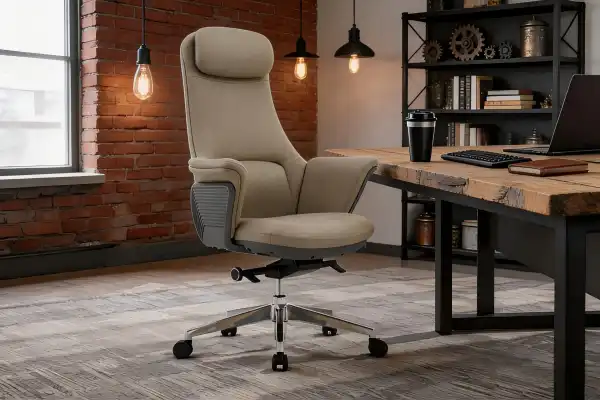
For general office use, task chairs support the middle of the back and give you a lot of options. Executive chairs have high backs, are made of high-quality materials, and have headrests for support. They are best for areas where senior employees or clients are present. Multi-shift or 24-hour chairs have stronger systems and thicker padding because they are made for places where the chair is never empty. By matching the type of chair to the function of the workspace, users can avoid premature wear and discomfort.
Top Features and Materials of Commercial Office Chairs for High-Traffic Use
Ergonomic Adjustment Features That Matter
Users can change the Pengpai Commercial Office Chair's round-knob lumbar support system to fit their own body shape. This is not a fixed cushion, but a real mechanism that responds to the user. The headrest can be adjusted for height and angle, and the flexible base has been thickened by 2.0 mm so that it can rock and recline. These are not just for looks; they have a direct effect on how your spine is aligned when you sit for long periods of time.
Material Comparison: Leather vs. Mesh Upholstery
The material used in Pengpai's business chair is nappa-pattern microfiber leather, which is durable, easy to clean, and looks professional. It works well in senior and catering settings. Mesh upholstery lets more air flow in hot places or for people who are busy, but it needs to be cleaned more carefully in healthcare settings. Premium microfiber leather strikes a good mix between longevity and good looks in high-traffic business settings.
Frame and Base Specifications
Here are the structural standards that show how reliable this chair is for business use:
- R350 aluminum alloy five-star base — tested under 1,136 kg static pressure in standard mechanical testing, confirming structural integrity for heavy-duty daily use.
- Electroplated Class 65 gas lift — tested through 100,000 up-and-down cycles, meeting the highest operational durability tier for pneumatic cylinders.
- 60mm gold-plated black casters — quiet-roll design tested through 100,000 standard operation cycles, protecting flooring while maintaining smooth mobility.
- High-density molded sponge across headrest, armrests, and seat cushion — retains shape and firmness over time, unlike standard foam that compresses within months.
These Commercial Office Chair specs show that the building is of a business grade, which is much higher than the standards for home furniture. This level of documented testing gives procurement teams in charge of multi-year deployments the confidence they need to place bulk orders.
Comparing Leading Commercial Office Chair Brands and Models
Global Benchmark Brands
People often say that Herman Miller and Steelcase make the best ergonomic task chairs. Models like the Aeron and Leap V2 have great reputations in business settings. Humanscale's Freedom Chair is famous for having a tilt system that changes based on your weight. HON has task seating that is both affordable and well-made, and it has strong BIFMA approval, which is popular with the government and institutions that buy things.
Where Pengpai Positions in This Market?
Pengpai's Commercial Office Chair is unique: it's an SGS CEC-certified, factory-direct executive chair that looks like a high-end model but is made with manufacturing-optimized production and OEM/ODM flexibility in mind. It fills the gap between expensive Western brands and cheaper generic imports. It comes in light gray and light orange, is certified to last five years, and is stocked in the Foshan warehouse for reliable lead times.
What B2B Buyers Gain From Direct-Manufacturer Sourcing?
When people buy straight from an integrated manufacturer like Pengpai, they can change the size and material, get help with engineering drawings, get uniform quality from samples to mass production, and work with dedicated project managers. This system makes it easier for distributors and fit-out workers to work on multiple projects at the same time, which keeps project deadlines safe.
Procurement and Transaction Considerations for B2B Buyers
Bulk Sourcing vs. Retail Channel Procurement
Retail buying works for small amounts, but it's not cost-effective for large amounts. By buying in bulk from a factory, you can get better unit prices, make sure that your production schedules are aligned, and choose the exact materials, finishes, and sizes that you need for each job. For projects with more than 50 units, working directly with the manufacturer almost always saves money and time.
Managing Lead Times and Delivery Reliability
When it comes to office fit-outs, hotel makeovers, and institutional upgrades, project deadlines are set in stone. Getting furniture late slows down the fitting process and raises the cost of the job. The Foshan warehouse of Pengpai keeps standard configurations in stock, and dedicated project managers make sure that production schedules are in line with client deadlines. This lowers the risk of delivery for contracts that need to be completed by a certain date.
Knock-Down Structure and Export Packaging
For international buyers, the cost of shipping directly affects the landed cost. For export, Pengpai's chairs are made with knock-down frames that reduce the amount of space needed for shipping and make assembly easier when they get to the destination. This design choice lowers the cost of freight per unit and the cost of installation labor, which are both very useful benefits that become even more significant when large orders are placed.
Conclusion
Picking the right chairs for a business or shared workspace is a purchase decision that impacts the health of employees, the cost of the project, and the management of the area in the long run. Commercial Office Chairs that are built to certified standards—with documented structural testing, ergonomic adjustments, and long-lasting materials—deliver significantly better results than home-grade chairs. The success of a project depends on how well you understand the key requirements and find the right manufacturing partner. This is true whether you are in charge of a government agency fit-out, a hotel renovation, or a multi-floor business growth. The benchmarks talked about here make it easy for procurement workers to make choices that they can be sure of.
FAQ
What makes a commercial office chair different from a home chair?
Commercial chairs meet BIFMA X5.1 standards for multi-user, extended daily use — typically 8 to 24 hours. They feature reinforced gas lifts, higher weight capacities, and durable upholstery rated for frequent cleaning. Home chairs are generally tested for lighter, shorter-duration use and are not built for high-traffic rotation.
How long should a quality commercial office chair last?
In a standard 8-hour office environment, a well-specified commercial chair should deliver 7–10 years of service life. Pengpai's commercial chair carries a five-year certified shelf life with an SGS CEC certificate and structural components tested through 100,000 operational cycles.
Does lumbar support actually reduce workplace injury?
Yes. Adjustable lumbar support maintains natural spinal curvature, reducing pressure on lumbar discs during prolonged sitting. The NIOSH recommends lumbar support as a standard ergonomic control measure for sedentary work. Pengpai's knob-adjustable lumbar mechanism allows users to fine-tune support to their individual body profile.
Can I order custom colors or materials for bulk projects?
Pengpai supports project-based customization including color, material, and dimensional modification. The standard commercial chair is available in light gray and light orange, with additional options available through direct consultation with the project team.
Is bulk purchasing cost-effective without compromising quality?
Direct factory sourcing at volume reduces unit cost while Pengpai's quality control system — covering material inspection, production monitoring, and pre-shipment checks — ensures consistency between samples and delivered goods.
Partner With PENGPAI for Your Next Commercial Office Chair Project
PenangSince 2008, I has been making and selling professional office chairs. Its factories are in Shunde, Foshan, which is Asia's biggest furniture manufacturing hub. Our line of "Commercial Office Chairs" is SGS CEC approved, in stock so we can ship them quickly, and OEM customization is available for folks who buy in bulk or work on projects. As a reliable Commercial Office Chair provider, we offer project managers, help with technical drawings, and supplies that are ready for sale from the very first day. You can ask for a quote by emailing kiki@pengpaifurniture.com or going to pengpai-furniture.com.
References
1. Business and Institutional Furniture Manufacturer's Association (BIFMA). BIFMA X5.1 General Purpose Office Chairs — Tests. BIFMA International, 2017.
2. Bureau of Labor Statistics, U.S. Department of Labor. Employer-Reported Workplace Injuries and Illnesses. BLS, 2022.
3. National Institute for Occupational Safety and Health (NIOSH). Work-Related Musculoskeletal Disorders and Ergonomics. Centers for Disease Control and Prevention, 2020.
4. Hedge, A. Ergonomic Workplace Design for Health, Wellness, and Productivity. CRC Press, 2017.
5. International Ergonomics Association. Ergonomics and Human Factors at Work. IEA Press, 2021.
6. Robertson, M. M., & O'Neill, M. J. Assessing the Health and Productivity Benefits of Ergonomic Office Seating Interventions. Journal of Occupational and Environmental Medicine, 2003.
Online Message