
Oct 10, 2026
Commercial Employee Office Desk Designs Support Productive Workstations, Team Collaboration, and Flexible Office Layouts
A well-designed commercial employee office desk does more than hold a monitor and keyboard. It shapes how people work, communicate, and feel throughout the day. Research from the International Facility Management Association shows that workspace design directly influences employee output and retention. Whether you manage procurement for a corporate headquarters, a government agency, or a hospitality group, selecting the right employee workstation is a decision with measurable consequences. This article walks through what makes a commercial-grade desk worth investing in and how to make the right choice for your team.
Understanding Commercial Employee Office Desks: Features, Benefits, and Materials
What Sets Commercial Desks Apart from Residential Ones?
A residential desk is made to be used only sometimes. A commercial-grade desk is made to be used for eight to ten hours a day, often over several shifts. The difference in structure is important. Commercial desks meet BIFMA X5.5 standards, which check for things like surface load capacity, structural stability, and long-term use. Over 100 kg can be put on these desks, and the joints are reinforced in a way that regular furniture just can't match.
Ergonomic Features That Matter
Ergonomics is not a nice-to-have; it's what you should expect. Musculoskeletal problems cause more than 30% of all accidents on the job, and most of them are caused by bad workstation design, according to OSHA. This is taken care of by commercial employee desks having enough surface area, cable management grommets built in, and the ability to work with monitor arms and keyboard trays. These features make it easier to focus and keep the desk surface clean and organized, which helps you stay focused for longer.
Materials: Durability, Maintenance, and Aesthetics
In commercial office furniture, Melamine Faced Chipboard (MFC) is the material that is used most often. E1-grade MFC panels control formaldehyde emissions while keeping the structure dense. For areas with a lot of foot traffic, 25 mm panels with 2 mm PVC edge bands are the standard because they are more durable against chipping and water absorption than thinner options. Metal frames that have been coated with epoxy powder make them more durable and resistant to rust. This makes them a good choice for places where there is HVAC exposure or a change in temperature.
How to Choose the Right Office Desk for Your Employees: A Decision Support Guide?
Define Role-Based Requirements First
Each worker doesn't need the same desk. A data scientist with three computers needs a different amount of space than a receptionist who takes calls and files paperwork. Before you look at the details, make a plan of how roles will be shared in your office. This makes sure that high-performance setups get to the employees who need them most and stops companies from buying too many high-end configurations for workstations that aren't being used much.
Fixed vs. Adjustable: Which Is Right for Your Project?
Here are the main differences between fixed and adjustable Commercial Employee Office Desk options that most people use to make decisions about what to buy:
- Fixed-height desks offer structural simplicity, lower per-unit cost, and straightforward installation. They suit stable, role-specific workstations in offices where employee assignments are consistent and turnover is low.
- Height-adjustable desks accommodate diverse body types and working preferences. In hybrid environments where desks are shared across shifts, adjustability reduces ergonomic complaints and supports worker comfort.
- Standing desk compatibility is increasingly requested in corporate fit-outs. Studies published in the British Journal of Sports Medicine found that alternating between sitting and standing reduced fatigue by up to 32% during the workday.
These differences help project managers and buying heads set budgets based on how the money will be used, not on guesses. The best cost-to-benefit ratio for most corporate offices that buy in bulk is a tiered method with fixed desks for normal workstations and flexible choices for leadership and shared zones.
Bulk Procurement Considerations
If you're buying fifty or more computers, it's important that the guarantee covers them, that spare parts are easy to find, and that the quality of the samples matches the quality of the production. Before giving the go-ahead for mass production, ask for actual models. Make sure that the sample's edge banding, color matching, and metal quality are the same as what will be given at scale.
Designing Productive Workstations and Promoting Team Collaboration Through Desk Layouts
Open-Plan vs. Private Workstation Configurations
Open floor plans make it easier for people to talk to each other without planning to and waste less space. Tech companies and startups where people from different departments often work together often have rows of connected benching desks. Panel-mounted privacy screens work better in private setups for jobs that need long-term focus, like managing financial, legal, or medical information. The right choice depends on the type of work, not just how nice the space looks.
Modular Desk Systems for Flexible Environments
Facilities teams can change plans with modular desk systems instead of buying new furniture. Desks with connectable structures—units that can be put next to each other or in groups—have much lower costs for reconfiguring. This is especially important for people who run co-working spaces and for government bodies that change who uses office space on a regular basis. When you have a system that allows for continuous connection, you can share conduit lines between units, which makes cable handling better across the floor plate.
Privacy Screens and Acoustic Considerations
Putting privacy screens on your desk does two things: it limits your view of your own workspace and keeps other people from seeing it. This small addition makes it easier to focus in offices with a lot of people. "Ability to work without interruption" is one of the top three factors in job happiness, according to research from the Leesman Index, which polls more than 750,000 workers around the world. This can be fixed with desk-mounted screens instead of full walls.
Latest Trends and Innovations in Commercial Employee Office Desks
Smart Desk Integration and Technology Readiness
Embedded technology is becoming more and more common in modern Commercial Employee Office Desk computers. It has USB charge ports built into the desk surface, flip-top wire grommets, and power strips that go under the desk. As wireless accessories become more common, people want desks with clean surfaces that don't have a lot of cords that can be seen. When looking for new office buildings, procurement workers should make sure that the desk specs include cutouts for technology and wire routing channels.
Sustainable Materials and Environmental Compliance
Large business buyers no longer have a choice but to get environmental certifications. E1-grade panel guidelines keep formaldehyde releases to 0.1 mg/m³ or less, which protects the air quality inside offices that are closed off. The PENGPAI Commercial Employee Office Desk is made entirely of E1-grade eco-friendly MFC panels, and it has been certified by both SGS and CEC to be in line with safety standards. This license paperwork makes it easier for U.S. buying teams working with government or healthcare clients to approve vendors.
Hybrid Work and Hot-Desking Design Demands
Because of the move toward hybrid work models, offices now use space in different ways. When employees hot-desk, which means they use any desk that's free instead of their assigned station, they need desks with personal storage that can be locked and a surface that can be reset easily between users. This need is directly met by mobile pedestal units with door locks, which keep personal things safe while letting the desk be cleared quickly for the next person to use it.
Procurement Insights: Where and How to Buy Commercial Office Desks for Your Business?
Evaluating Suppliers: What to Look For
When comparing office desk providers, whether they are well-known brands like Herman Miller and Steelcase or integrated makers like PENGPAI, there are four useful things to look at: the certification of the materials used, the production capacity, the level of customization available, and the company's experience exporting. Integrated makers, who run both production and sales, can keep a closer eye on quality and coordinate projects more easily than wholesalers who act as middlemen.
The PENGPAI Commercial Employee Office Desk: Product Specifications
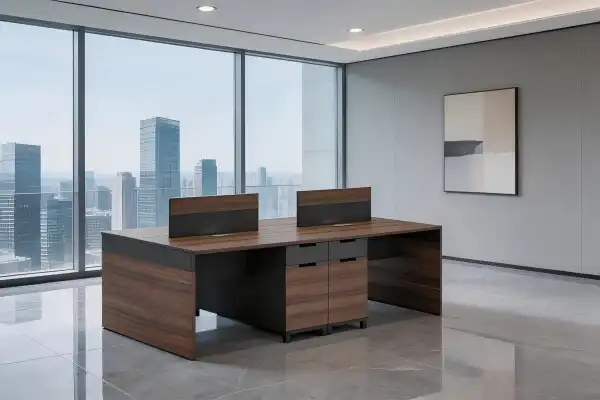
The PENGPAI Commercial Employee Office Desk (2400W × 1200D × 1050H mm) is made from E1-grade MFC panels. The desktop and legs are 25 mm thick with 2.0 mm edge banding, and the secondary parts are 16 mm thick with 1.5 mm edging. The Cana Teak + Milan Gray finish gives the furniture a professional look that works well in both business and hospitality settings. Here are the main basic parts of the product:
- Two desktop-mounted privacy screens define personal workspace without requiring floor-level partitions
- Central three-drawer mobile pedestal with drawer locks for secure personal storage and hot-desk compatibility
- Fixed side cabinets with damping soft-close hinges for quiet, durable operation
- Moisture-proof gray plastic support feet for floor protection and leveling stability
- Continuously connectable structure allowing row configuration for open-plan environments
—Two desktop-mounted private screens separate personal area without the need for floor-level walls
Maintenance and Long-Term Performance
MFC surfaces don't need special cleaning products and can handle common office spills. Using a wet cloth to wipe down keeps the finish in good shape without hurting the plastic layer. The soft-close hinges and lockable drawers have been tried and have cycle ratings that are many times higher than the average yearly usage rates in an office. This backs up the desk's five-year performance estimate.
Conclusion
Choosing the right Commercial Employee Office Desk configuration affects how people work each day, how well space is used, and how much the facility costs in the long run. When built with the right materials and standards, commercial-grade workstations do better than residential options in every way that matters to a business. The choices made during the procurement stage determine whether a workspace helps or hurts the people who use it. These choices include ergonomic compliance and modular layout flexibility. PENGPAI's product line is designed to meet these exact needs, with certified products that are in stock to meet project deadlines.
FAQ
What is the standard size for a commercial employee desk?
Standard office desks for employees in open-plan spaces are usually between 1400mm and 2400mm wide. The size of the PENGPAI model is 2400W × 1200D × 1050H mm, which is big enough for dual-monitor sets and managing documents without taking up too much space in high-density plans.
What does E1-grade MFC mean for indoor air quality?
As long as the formaldehyde level is at or below 0.1 mg/m³, E1-grade MFC panels meet the standards for household air quality in both Europe and the United States. Because of this, they can be used in closed offices, schools, hospitals, and other places where people spend long hours every day.
Can these desks be reconfigured after installation?
Yes. The PENGPAI desk has a structure that can be constantly connected, so units can be put together in rows or split up into different stations. This lets you change the plan in the future without having to buy new furniture.
How long does a commercial office desk typically last?
With proper care and construction that meets BIFMA standards, commercial-grade desks can last between ten and fifteen years. The PENGPAI type has a shelf life of five years that is approved by SGS and CEC.
What certifications should I verify before purchasing?
Check that it meets E1 or CARB Phase 2 formaldehyde standards, goes through BIFMA structure testing, and is verified by SGS or a similar third party. These approvals show that the structure is safe and reliable for business use.
Ready to Source Your Next Office Workstation? Contact PENGPAI Today
Since 2008, PENGPAI has sold Commercial Employee Office Desks and full desk furniture options to businesses, government agencies, and leisure groups around the world. As a verified manufacturer of Commercial Employee Office Desks with in-house production, E1-certified materials, and dedicated project management, we can help with bulk purchases from the time you plan the layout to the time you deliver the desks. You can email our team at kiki@pengpaifurniture.com or go to pengpai-furniture.com to get specs, samples, or a quote for your job.
References
1. International Facility Management Association. Workplace Productivity and Space Planning Report. IFMA, 2022.
2. BIFMA International. BIFMA X5.5: Desk/Table Products Standard. Business and Institutional Furniture Manufacturers Association, 2021.
3. Occupational Safety and Health Administration. Ergonomics: Computer Workstations. U.S. Department of Labor, 2023.
4. Hedge, A., & Ray, E. "Sit-Stand Desks and Their Effect on Worker Fatigue." British Journal of Sports Medicine, 2015.
5. Leesman Index. The Workplace Experience Revolution: Leesman Review. Leesman, 2023.
6. U.S. Green Building Council. LEED v4 Indoor Environmental Quality Credits: Low-Emitting Materials. USGBC, 2020.
Online Message